Seroprevalence of the hepatitis C virus in the population with social security in Nogales, Sonora
Jesús Antonio Pérez-Mercado and Edgar Daniel Copado-Villagrana
Hospital General de Zona No. 5, Instituto Mexicano del Seguro Social, México 15D, 84094, Heroica Nogales, Sonora.
Abstract
Introduction: Hepatitis C virus (HCV) infection represents a global public health problem. According to estimates by the World Health Organization (WHO), 58 million people are chronically infected, and 29,000 related deaths occurred in 2019 alone. In Mexico, the Specific Action Plan establishes the objective of reducing its incidence by increasing the rate of diagnosis and initiation of timely treatment as a response to its elimination. However, despite the existence of the Standardized Procedures Manual for the Epidemiological Surveillance of Viral Hepatitis, the real burden of the disease remains underestimated. Challenges persist in the integration of data between institutions and the active identification of cases, leading to significant underreporting that hinders a precise understanding of the infection's current epidemiology in Mexico.Objetive: To determine the seroprevalence of anti-HCV antibodies in beneficiaries enrolled in the Family Medicine Unit of Nogales, Sonora.
Materials and methods: A cross-sectional study was designed and included beneficiaries assigned to the family medical unit. Clinical, demographic, and epidemiological information was obtained through the electronic medical record, and a bivariate analysis was subsequently performed to compare these data with those of exposure to the virus. A P value <0.05 was considered statistically significant. The study was approved by Local Health Research Committee 2603 of the Mexican Social Security Institute. All subjects included authorized testing by signing an informed consent form.
Results: Of the total cases analyzed, four had a reactive rapid test result. Statistically significant differences were found between reactive and nonreactive patients regarding history of transfusions, contact with people with hepatitis, tattoos or piercings, intranasal drug use, and risky sexual practices.
Conclusions: The HCV seroprevalence rate among patients enrolled in the medical unit studied is 2.8%, and some of the backgrounds studied could represent risk factors for infection.
Keywords: Hepatitis C, seroprevalence, Mexico, epidemiological surveillance, rapid test.
INTRODUCTION
The hepatitis C virus (HCV) is one of the most underdiagnosed pathologies by healthcare institutions, due to the lack of awareness among the population about this disease and among healthcare personnel about new eradication schemes, and, in turn, the limited availability of screening tests in healthcare services.1
Hepatitis C is a viral disease caused by an RNA virus that replicates in liver cells without causing an immediate cytopathic effect, thus causing a chronic infection.3 It is a small, circular, lipid-enveloped virus with positive-sense single-stranded ribonucleic acid (RNA), belonging to group IV of the Baltimore classification, and therefore can be immediately translated into the host cell and replicate in the cell cytoplasm. It belongs to the Flaviviridae family, the Hepacivirus genus, and the Hepatitis C virus (HCV) species. Its total genome is approximately 9.6 kb, with 5' and 3' untranslated regions at both ends. It is composed of 10 proteins, including three structural proteins (C, E1, and E2) and seven nonstructural proteins (P7, NS2, NS3, NS4A, NS4B, NS5A, and NS5B). The structural proteins are important components of the nucleocapsid, while the core proteins modulate gene transcription and cell proliferation. It is transmitted parenterally and is hepatotropic.5
Susceptibility to HCV is general in humans, as there is still no vaccine due to the virus's high genetic variability at the envelope level. HCV has been characterized into six main genotypes (genotypes 1 to 6) and numerous subtypes (designated as a, b, c, etc.). Genotypes 1, 2, and 3 have a worldwide distribution, with type 1 (1a and 1b) being the most common. In hepatitis C, the influence of viral genotype is more closely related to the pathogenesis of liver disease than to any epidemiological factor.4
According to the World Health Organization (WHO), 71 million people worldwide are infected with this virus and are at risk of developing liver cancer or cirrhosis, although most of them are unaware of their serological status. The total number of deaths attributable to viral hepatitis because of acute infection is 1.4 million per year worldwide, 48% of which correspond to HCV.8
The impact of this pathology is particularly critical in Mexico, where liver cirrhosis represents the fourth leading cause of death and a primary driver of disability-adjusted life years (DALYs). Recent evidence highlights that a significant proportion of these cases are attributable to chronic HCV infection, which often remains silent until advanced stages of fibrosis occur. Given this epidemiological landscape, the national strategy focuses on breaking the link between chronic infection and end-stage liver disease through early detection.34
Genotype 1 is the most common in Mexico, with a frequency of approximately 75%. This type of virus most frequently has the worst outcome and responds least to treatment.6 The virus has a half-life of 2.7 hours in the blood, and there is a high daily production of viral particles (1012) in patients with chronic infection; viral replication kinetics are even higher than those of HIV. Second, the enzyme responsible for replication has an error rate of approximately 10-4 and therefore a mutation rate (quasi-species) that facilitates treatment escape mechanisms.7
It is estimated that there are around 600,000 infected people in our country.9 Mexico has the third highest viral load for hepatitis C in the Americas, behind only the US and Brazil.10
Of seropositive patients screened for HCV in Mexico, 65% have chronic infection, but of these, only approximately 25% know they have the disease, and only approximately 1% receive treatment. The national prevalence is between 1.2% and 1.4%, with the northern region being the highest at 2% and even reaching 96% among drug users, followed by the southern and central regions of the country with 1.5% and 1.1%, respectively. 11, 12, 13 The prevalence of HIV-HCV infection is 0.6% to 2.8% in the Mexican population.14
In Mexico, epidemiological surveillance of viral hepatitis is mandatory and is governed by the Standardized Procedures Manual for the Epidemiological Surveillance of Viral Hepatitis, coordinated by the General Directorate of Epidemiology (DGE). This system integrates case notification through the National Standardized Surveillance System (SUIVE) and is complemented by the National Program for the Elimination of Hepatitis C. This framework aims to transition from passive surveillance to the active identification of cases in high-risk populations to achieve elimination goals.35
In the information systems of the Ministry of Public Health in Sonora, 14 cases of hepatitis C were reported during 2020, and as of epidemiological week 40 of 2021, 159 cases have been reported. 17
The Mexican Social Security Institute (IMSS) houses 70% of patients diagnosed with Hepatitis C. In 2019, 1,107 of the 2,378 cases reported in Mexico corresponded to beneficiaries, of which 41 cases were from the Institute. Mexican Social Security Institute, Sonora.18
Many factors can determine disease progression, hence the need for early identification of affected patients and careful monitoring to determine the risk of progression, the need for appropriate therapeutic intervention, and verification of viral elimination. Thus, the primary beneficiaries of this study will be the beneficiaries of Family Medicine Unit Number 5, for whom early intervention will be possible to ensure timely initiation of treatment.
The overall objective is to determine the seroprevalence of Hepatitis C Virus antibodies in beneficiaries assigned to Family Medicine Unit Number 5 (FMU 5) in Nogales, Sonora.
MATERIALS AND METHODS
This research project was an epidemiological study with a quantitative approach, a descriptive scope, and an observational and cross-sectional design. Data collection was carried out using a time-based, cross-sectional design.
Beneficiaries over 18 years of age or with risk factors for HCV infection who agreed to participate in the study through an informed consent form were included.
Beneficiaries under 18 years of age without risk factors for HCV infection who refused to provide consent for inclusion in the study were excluded. Those under 18 years of age with risk factors for whom a parent or guardian did not provide consent for inclusion in the study were excluded. Those not receiving IMSS benefits were excluded. Those receiving IMSS benefits assigned to another Family Medical Unit. Those with a previously confirmed diagnosis or receiving treatment for HCV infection were excluded.
Beneficiaries who refused to answer the questions on the data collection form or those who did not answer all of the questions were excluded. The sample size was calculated with a confidence interval of 99% (Zα2 =2.58), a margin of error of 3% (d= 0.03), taking the population assigned to UMF 5 of 112,676 beneficiaries and a prevalence of 2% (p= 0.02) previously reported in northern Mexico, a sample size of 145 subjects to be studied was calculated. The dependent variable was the presence of positive anti-HCV antibodies, and the independent variables were age, gender, neighborhood of residence, occupation, blood transfusions, chronic diseases, history of hepatitis A vaccination, hepatitis B vaccination, number of pregnancies, history of contact with patients with hepatitis, rural residence, presence of tattoos, piercings, or eyeliner, intravenous drug use, organ transplant, HIV infection, child of a mother with HCV, unprotected sexual contact, sexual partner with HCV, history of incarceration, hemodialysis, health professional, work-related accident involving a sharp object, contact with catheters and endoscopes, and symptoms compatible with hepatitis C.
Participants signed an informed consent form authorizing participation in this protocol prior to the screening process. For statistical analysis, absolute and relative frequencies of the independent variables were determined, as well as bivariate analysis using the χ2 statistical test for parametric tests or, alternatively, Fisher's Exact Test for nonparametric tests. Finally, the odds ratio of the prevalence was calculated with a 95% confidence interval.
The project adhered to the General Health Regulations on Health Research and requested authorization from the Local Health Research and Ethics Committee, as well as from the authorities of Family Medicine Unit No. 5 in Nogales, Sonora.
In the event of a positive result with the rapid Hepatitis C virus antibody detection test, the subjects were informed of this condition, informed of the warning signs, and provided measures to prevent transmission of the virus to other subjects.
During the research, the privacy and dignity of the research subject were protected, respecting the bioethical principles of beneficence, nonmaleficence, autonomy, and justice.
RESULTS
The total number of patients included was 145 Mexican Social Security Institute beneficiaries assigned to Family Medicine Unit No. 5 in Nogales, all over the age of 18, who underwent the rapid hepatitis C antibody test.
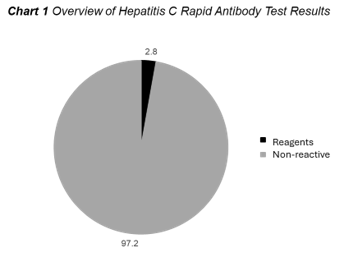
Of the 145 rapid hepatitis C antibody tests performed, 4 were reactive (2.8%), and 141 tests showed no reactivity to hepatitis C (Chart 1).
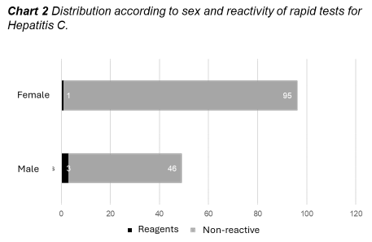
Of the total subjects analyzed, 96 were female and 49 were male. According to the rapid test reactivity, 3 were male and 1 was female (Chart 2).
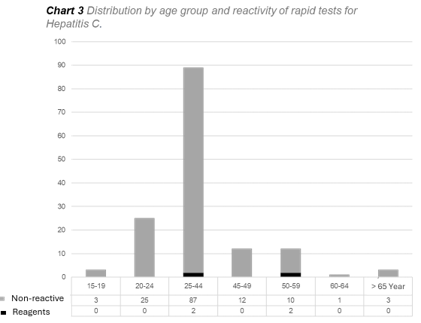
Regarding the distribution of the study population by age group, it is observed that 3 people are in the 15-19 age group, 25 in the 20-24 age group, 87 in the 24-44 age group, 12 in the 45-49 age group, 10 in the 50-59 age group, 1 in the 60-64 age group, and 3 in the over-65 age group. Of these, those reactive to rapid antibody tests were in the 25-44 and 50-59 age groups, accounting for 50%, respectively (Chart 3).
The clinical and sociodemographic variables of the study population are shown in Table 1.
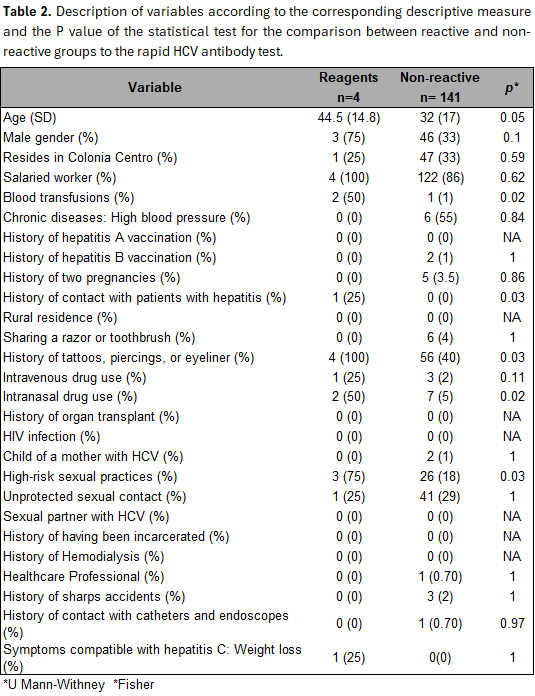
Table 2 presents a summary of the clinical and sociodemographic variables with respect to the corresponding frequency measure and the P value of the statistical test used to compare the groups (reactive and nonreactive in the rapid Hepatitis C antibody test).
Statistically significant results (p < 0.05) were found in the variables analyzed: history of blood transfusions, history of tattoos, piercings, or eyeliner, and history of intranasal drug use, each with a P value of 0.02. History of contact with patients with Hepatitis and risky sexual practices, respectively, with a P value of 0.03, were found. These could represent risk factors for infection.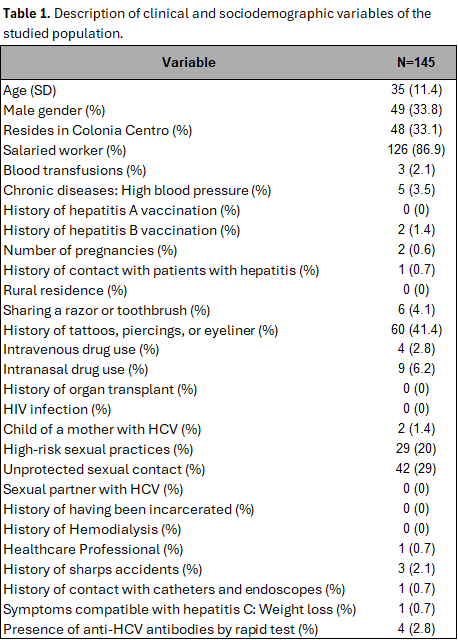
DISCUSSION
According to the Specific Action Program for the Hepatitis C Virus 2020-2024, it is difficult to determine the actual seroprevalence of Hepatitis C in
Mexico due to the lack of an adequate reporting system and the limited research studies available.11
In 2000, the National Health and Nutrition Survey (ENSANUT) reported a prevalence of infection of 1.4% in Mexico, and referred to a difference based on the country's regions, reporting an estimate of 2.0% for the north, 1.5% for the south, and 1.1% for the center of the country. In 2018, ENSANUT reported a national prevalence of Hepatitis C antibodies of 0.38%, lower than the first estimate.14, 30
In the present investigation, based on the results obtained, it was demonstrated that the seroprevalence of hepatitis C among IMSS beneficiaries assigned to Family Medicine Unit No. 5 in Nogales, Sonora, is 2.8%, a figure higher than the estimate for the northern part of the country.
Carnalla et al (2021) sampled 12,389 adults who responded to the National Health and Nutrition Survey (ENSANUT) in 2018 and reported that the anti-HCV seroprevalence obtained in the population aged 20 to 49 years was 0.23%, being higher in the male population and in those living in urban areas. They also showed that the prevalence in the 50 years and older group was higher, being 0.59%.31 In the present study, it was found that patients with a reactive result to the rapid HCV antibody test were found in the 25 to 44 and 50 to 59 age groups. In addition, 100% of them live in urban areas and 75% of those reactive to the rapid test were male. Of the 145 Hepatitis C screenings performed on the population assigned to Family Medicine Unit No. 5 in Nogales, 66.2% were female and 33.8% were male. The positivity rate among men is noteworthy, standing at 6% in this group, and 1% among women, a situation similar to that described by Carnalla et al. (2021).31 The gender disparity in screening may be due to the low acceptance among the male population of seeking preventive medicine for screening or medical consultations.32
Contreras et al. In a study on risk factors for acquiring HCV in Hidalgo, it was reported that 24.43% had a history of high-risk sexual practices, 19.88% had tattoos or piercings, 12.5% had a history of close contact with hepatitis C patients, as well as that 7% had received a blood transfusion in their life and that 1.70% had used inhaled drugs at some point; A similar situation was reported in the present study. 33
The clinical, epidemiological, and demographic factors of the cases analyzed in the research were determined. For each variable, the frequency of the rapid Hepatitis C antibody test result and its statistical significance were obtained. It was found that a history of having had a blood transfusion, having tattoos, piercings, or eyebrow threading, having ever used intranasal drugs, having or having had close contact with a Hepatitis C case, and engaging in risky sexual practices could be clear risk factors for contracting this infection. However, due to the design and objectives, as well as the methodology used for this study, a risk analysis was not performed. It is important to note that this study sought to determine antibody prevalence, that is, to determine how much of the population has been exposed to hepatitis C. It did not focus on determining the active burden of the disease (quantification of HCV RNA). As has been described, there is a percentage of people who spontaneously achieve viral clearance and the infection does not progress. Therefore, it was decided in this protocol to begin HCV screening and provide an opportunity for other researchers interested in the topic to analyze the patients' progress.
Finally, one of the limitations encountered during the sampling process was the low acceptance among the population of undergoing rapid antibody testing for hepatitis C, as well as for HIV and syphilis. Therefore, mass awareness campaigns regarding these diseases are necessary.
REFERENCES
1. Carreño García V, Nebreda JB, Aguilar IC, Quiroga Estévez JA. Infección oculta por el virus de la hepatitis C. Enferm Infecc Microbiol Clin. [En línea]. 2011 [Consultado el 12 de julio de 2021]; 29:14–9.
2. Dunford L, Carr MJ, Dean J, Waters A, Nguyen LT, Ta Thi TH, et al. Hepatitis C virus in Vietnam: high prevalence of infection in dialysis and multi-transfused patients involving diverse and novel virus variants. PLoS One. [En línea]. 2012 [Consultado el 15 de abril de 2021]; 7(8):e41266.
3. Fundación Mexicana para la Salud Hepática. La hepatitis C como un problema de salud pública en México. Salud pública Méx. [En línea]. 2011 [Consultado el 10 de agosto de 2021; 53(1):S61-S67.
4. Fundación Mexicana para la Salud AC. Webinar “Un frente contra la eliminación de la Hepatitis” [En Línea]. México: Youtube; 2021 [Consultado el 13 de agosto de 2021].
5. Rojo-Medina J, Bello-López JM. National prevalence of hepatitis C and B viruses in Mexican blood donors, 2000–2012. Rev médica Hosp Gen Méx. [En línea]. 2017 [Consultado el 17 de julio de 2021]; 80(1):37–44.
6. Aguilera Guirao A, Romero Yuste S, Regueiro BJ. Epidemiología y manifestaciones clínicas de las hepatitis virales. Enferm Infecc Microbiol Clin. [En línea]. 2006 [Consultado el 22 de agosto de 2021]; 24(4):264–76.
7. Cadena-Martínez MC. Conductas de riesgo e infección de Hepatitis C: La importancia de la detección oportuna mediante tamizaje en población vulnerable adscrita al IMSS, Iztapalapa, 2015-2016. [Tesis en línea]. México: Instituto Nacional de Salud Pública; 2017 [Consultado el 12 de agosto de 2021].
8. Vera DL, Juárez NJA, Díaz GM, et al. Panorama epidemiológico y situacional de la hepatitis C en México. Rev Gastroenterol Mex. [En línea]. 2005 [Consultado el 17 de julio de 2021]; 70(1):25-32.
9. Dirección General de Epidemiología. Manual de Procedimientos Estandarizados para la Vigilancia Epidemiológica de las Hepatitis Virales. [En Línea]. México: Secretaría de Salud; [Actualizado el 01/09/2012, Consultado el 20 de junio de 2021].
10. Cooke GS, Andrieux-Meyer I, Applegate TL, Atun R, Burry JR, Cheinquer H, et al. Accelerating the elimination of viral hepatitis: a Lancet Gastroenterology & Hepatology Commission. Lancet Gastroenterol Hepatol. [En línea]. 2019 [Consultado el 11 de junio de 2021]; 4(2):135–84.
11. Programa de Acción Específico Virus de Hepatitis C 2020-2024. México: Secretaría de Salud [En Línea]. Consultado el 1 de junio de 2021.
12. Panduro A, Melendez GE, Fierro NA, Madrigal BR, Zepeda-Carrillo EA, Román S. Epidemiología de las hepatitis virales en México. Salud Publica Mex. [En línea]. 2011 [Consultado el 22 de julio del 2021]; 53:S37–45.
13. Gutiérrez JP, Sucilla-Pérez H, Conde-González CJ, Antonio Izazola J, Romero-Martínez M, Hernández-Ávila M. Disminución de la seroprevalencia de hepatitis C en México: resultados de la Ensanut 2012. Salud Publica Mex. [En línea]. 2016 [Consultado el 21 de julio del 2021]; 58(2):25–32.
14. Valdespino JL, Conde-González CJ, Olaiz-Fernández G, et al. Seroprevalencia de la hepatitis C en adultos de México: ¿un problema de salud pública emergente? Salud Pública Mex. [En línea]. 2007 [Consultado el 13 de agosto de 2021]; 49(3):395-403.
15. CENSIDA. Guía rápida para la atención de personas con Virus de la Hepatitis C (VHC) en los establecimientos de salud. México: Secretaría de Salud; [Actualizado el 17/07/2020, Consultado el 18 de junio de 2021].
16. Murguía-Martínez P, Kuri-Morales P. Panorama epidemiológico de las hepatitis virales en México [En línea]. 1997 [Consultado el 22 de julio del 2021].
17. Dirección General de Epidemiología. Boletín Epidemiológico, Sistema Nacional de Vigilancia Epidemiológica, Sistema Único de Información. México: Secretaría de Salud; [Actualizado el 18/10/2021, Consultado el 20 de octubre de 2021].
18. Dirección General de Epidemiología. Anuario de Morbilidad 1984-2019, Casos de enfermedad por fuente notificante. [En Línea]. México: Secretaría de Salud; [Actualizado el 01/10/2021, Consultado el 20 de junio de 2021].
19. Ramírez-Zamudio LC, Castillo-Barradas M. Seroprevalence of the hepatitis C virus in healthcare personnel of the IMSS. Rev Gastroenterol Méx (Engl Ed). [En línea]. 2020 [Consultado el 20 de agosto de 2021]; 86(4):335–9.
20. Contreras-Omaña R, García-Lemus FJ, García-Camacho A. Factores de riesgo para adquirir VHC en una institución de salud en Hidalgo. Rev Gastroenterol Méx (Engl Ed). [En línea]. 2019 [Consultado el 13 de agosto de 2021]; 84(1):36–43.
21. Wolpert-Barraza E, Muñoz-Hernández O, Kershenobich-Stalnikowitz D, Coalición para el estudio de la hepatitis C en México., Coalición para el estudio de la hepatitis C en México. Acciones prioritarias para un programa nacional de detección, tratamiento y seguimiento de pacientes con hepatitis C. Salud Publica Mex. [En línea]. 2019 [Consultado el 25 de mayo de 2021]; 61(2):212–6.
22. Burguete-García AI, Conde-González CJ, Jiménez-Méndez R, Juárez-Díaz Y, Meda-Monzón E, Torres-Poveda K, et al. Hepatitis C seroprevalence and correlation between viral load and viral genotype among primary care clients in Mexico. Salud Publica Mex. [En línea]. 2011 [Consultado el 15 de agosto de 2021]; 53(1):S7-12.
23. Instituto de Diagnóstico y Referencia Epidemiológicos “Dr. Manuel Martínez Báez”. Lineamientos para la Vigilancia por laboratorio de las Hepatitis Virales, INDRE. [En Línea]. México: Secretaría de Salud; [Actualizado el 01/02/2017, Consultado el 20 de junio de 2021
24. Iñarrairaegui M, Elizalde I, Martínez Echeverría A, Zozaya JM, Beloqui R, Martínez-Peñuela JM. Infección crónica por el VHC. An Sist Sanit Navar. [En línea]. 2004 [Consultado el 20 de agosto de 2021]; 27:69–81.
25. Santiago-Torres LE, Camacho-Calderón N, Guerrero-Rodríguez GG. Seroprevalencia de hepatitis C en usuarios de unidades de medicina familiar en Querétaro, México. Aten fam. [En línea]. 2015 [Consultado el 15 de abril de 2021]; 22(1):2–6.
26. Aiza-Haddad I, Ballesteros-Amozurrutia A, Borjas-Almaguer OD, Castillo-Barradas M, Castro-Narro G, Chávez-Tapia N, et al. The Mexican consensus on the treatment of hepatitis C. Rev Gastroenterol Méx (Engl Ed). [En línea]. 2018 [Consultado el 21 de agosto de 2021]; 83(3):275–324.
27. Valdez-Hernández P, Rodríguez-Aguilar EF, Páez-Zayas VM, Lizárraga-Gómez E, García-Juárez I. Propuesta de un esquema simple de antivirales de acción directa para tratamiento de VHC en un sistema de salud público con bajo presupuesto. Salud Publica Mex. [En línea]. 2018 [Consultado el 21 de julio del 2021]; 60(6):738–40.
28. Mar J, Ibarrondo O, Martínez-Baz I, Juanbeltz R, San Miguel R, Casado I, et al. Economic evaluation of a population strategy for the treatment of chronic hepatitis C with direct-acting antivirals. Rev Esp Enferm Dig. [En línea]. 2018 [Consultado el 13 de agosto de 2021]; 110(10):621–8.
29. Arriola M. La apuesta del IMSS por la cura de la hepatitis C. [En Línea]. México: El Universal. [Actualizado el 20/07/2017, Consultado el 16 de julio de 2021].
30. Instituto Mexicano del Seguro Social. Guía para la implementación del Programa de Microeliminación de la Hepatitis C en el Instituto Mexicano del Seguro Social. México: IMSS; 2020.
31. Carnalla M, Barrientos-Gutiérrez T, Vidaña-Perez D, Romero-Martínez M, Martínez-Bohorquez MC, González-Pier E, et al. Prevalence of hepatitis C in the adult Mexican population: National Survey of Health and Nutrition 2018. Lancet Reg Health Am [En Línea]. 2022;8(100165):100165.
32. El hombre y la mujer enferman en forma diferente. Rev. Fac. Med. (Méx.) [En Línea]. 2014. [Consultado el 09 de noviembre de 2023]; 57(2):53-56.
33. Contreras-Omaña R, García-Lemus FJ, García-Camacho A. Factores de riesgo para adquirir VHC en una institución de salud en Hidalgo. Rev Gastroenterol Mex [Internet]. 2019 [citado el 9 de noviembre de 2023];84(1):36–43.
34. Méndez-Sánchez N, Zamarripa-Dorantes G, et al. Current and future sentinel of liver disease in Mexico: A review. Lancet Reg Health Am [En Línea]. 2022;7:100161. [Consultado el 10 de marzo de 2026]. doi:10.1016/j.lana.2021.100161.
35. Secretaría de Salud. Manual de procedimientos estandarizados para la vigilancia epidemiológica de las hepatitis virales. Dirección General de Epidemiología [En Línea]. 2021. [Consultado el 10 de marzo de 2026].
Citation
Pérez-Mercado JA and Copado-Villagrana ED, Seroprevalence of the hepatitis C virus in the population with social security in Nogales, Sonora., ERSJ 2026,2(2) 119-132
Academic editor: Gabriel Valle Alvarado, Received: July-29- 2025, Revised: August-11- 2025, Accepted: October-01-2026, Published: October-18-2026.