Epidemiological Profile of Patients with Severe Maternal Morbidity in a Hospital in Sinaloa (2021–2024)
Patricia Paola García de León-Carreón¹, Marcelo Eduardo Medina-Valdez², José Luis Félix-Heredia³, Alberto Bojorquez-Olguin4
¹ Resident Physician in Obstetrics and Gynecology, Hospital de Gineco-Pediatría No. 2, Instituto Mexicano del Seguro Social (IMSS), Órgano de Operación Administrativa Desconcentrada (OOAD) Sinaloa, Los Mochis, Sinaloa, Mexico.
² Non-Family Specialist Physician in Epidemiology, Hospital de Gineco-Pediatría No. 2, Instituto Mexicano del Seguro Social (IMSS), Órgano de Operación Administrativa Desconcentrada (OOAD) Sinaloa, Los Mochis, Sinaloa, Mexico.
³ Clinical Coordinator of Education and Health Research, Hospital de Gineco-Pediatría No. 2, Instituto Mexicano del Seguro Social (IMSS), Órgano de Operación Administrativa Desconcentrada (OOAD) Sinaloa, Los Mochis, Sinaloa, Mexico.
4 Non-Family Specialist Physician in Epidemiology. Unidad de medicina familiar número 36, Instituto Mexicano del Seguro Social (IMSS), OOAD Sinaloa, Humaya, Sinaloa, Mexico.
Abstract
Introduction: Extremely severe maternal morbidity (ESMM) encompasses critical obstetric conditions during pregnancy, childbirth, or the puerperium where timely medical intervention prevents maternal death, serving as a key indicator of quality of care.Objetive: To determine the epidemiological and clinical profile of patients with extremely severe maternal morbidity treated at Hospital de Gineco-Pediatría No. 2 from 2021 to 2024.
Materials and methods: A cross-sectional, descriptive, and retrospective study based on the full census of 188 patients registered in the SIVEMMEG platform. Sociodemographic, gynaeco-obstetric, causal pathology, comorbidity, and perinatal outcome variables were analyzed using descriptive statistics in SPSS v.25.
Results: A total of 188 cases were included (43 in 2021, 56 in 2022, 46 in 2023, and 43 in 2024). The median age was 27 years (range: 14 to 46). Severe preeclampsia was the leading cause of ESMM at 62% (n=117), followed by hypovolemic shock at 20% (n=38), eclampsia at 13% (n=25), and septic shock at 4% (n=8). Comorbidities were identified in 26%, with obesity (19%) and diabetes mellitus (4%) standing out. 100% had adequate prenatal care (≥5 visits). Delivery was by cesarean section in 89% (n=167). The maternal outcome was favorable in 99% (n=187). 97% of neonates were born alive, with 54% (n=102) requiring admission to the NICU.
Conclusions: Hypertensive disorders of pregnancy remain the main etiology of ESMM. Strengthening early identification in primary care and prompt hospital-level management are essential to reduce critical maternal morbidity and neonatal intensive care admissions.
Keywords: Extremely Severe Maternal Morbidity; Preeclampsia; Eclampsia; Obstetric Hemorrhage; Maternal Health.
INTRODUCTION
The epidemiological profile of patients with extremely severe maternal morbidity (ESMM)—also conceptualized internationally as maternal near miss—constitutes a priority axis in epidemiological surveillance and the continuous evaluation of obstetric care quality. ESMM is defined as a critical clinical condition occurring during pregnancy, childbirth, or the puerperium (up to 42 days post-pregnancy termination), in which a woman's life is in imminent danger but she survives due to timely medical-surgical interventions and advanced life support. 1, 2 These patients represent survivors of potentially catastrophic obstetric events that, in the absence of an effective and decisive healthcare response, would have resulted in maternal death.1
Maternal health represents a fundamental indicator of socioeconomic progress and health equity in a nation. As maternal mortality rates have declined in various regions due to improvements in healthcare infrastructure, the World Health Organization (WHO) has proposed monitoring severe maternal morbidity as a key indicator of performance and healthcare safety 1, 2. The WHO Maternal Morbidity Working Group defines maternal morbidity as any chronic or acute health condition originating or aggravated by pregnancy that negatively impacts maternal well-being.3 In 2011, the WHO formalized criteria based on five life-threatening conditions (severe postpartum hemorrhage, severe preeclampsia, eclampsia, sepsis, and uterine rupture), critical interventions (admission to an intensive care unit or emergency exploratory laparotomy), and specific organ dysfunctions.4 However, variability in diagnostic criteria at the global level still disparities in estimating its true burden.5
At the global epidemiological level, it is estimated that for every maternal death, approximately 70 cases of ESMM occur.1, 2 Paradoxically, in some high-income countries, such as the United States, ESMM rates have not decreased but doubled between 1998 and 2014, attributable to reproductive aging, the increasing prevalence of obesity, pregestational diabetes, arterial hypertension, and an exponential increase in cesarean section rates.6
In Mexico, severe maternal morbidity represents a public health problem of high significance determined by social disparities and lags in reproductive health.7, 8 International commitments, from the Millennium Development Goals to the Sustainable Development Goals (2030 Agenda), require reducing the maternal mortality ratio to fewer than 70 per 100,000 live births 9. For countries with intermediate or low baseline rates, the primary challenge lies in identifying and mitigating preventable extreme morbidity; in Latin America, it is estimated that for every maternal death, up to 20 cases of severe morbidity occur, a quarter of which face permanent sequelae.10, 11, 12
In response to this need, the Secretariat of Health implemented the Epidemiological Surveillance System for Severe Maternal Morbidity (SIVEMMS/SIVEMMEG) since 2014, which categorizes cases using three direct criteria: tracer pathologies (eclampsia, hypovolemic shock, septic shock, systemic lupus erythematosus), organ failures or dysfunctions (cardiovascular, renal, hepatic, cerebral, respiratory, or hematological), and advanced medical-surgical management (ICU admission, obstetric rescue surgery, or acute blood transfusion). 12 Recognized risk factors in the literature include the extremes of maternal age (<20 and >35 years), pre-existing comorbidities, disadvantaged socioeconomic status, and a history of prior uterine surgery.13, 14, 15, 16 International systematic reviews demonstrate variable maternal near-miss rates ranging from 3.9 to 379.5 per 1,000 live births.17, 18, 19, 20, 21, 22, 23
Nationally, Sinaloa ranks among the 15 federal entities with the highest index of maternal morbidity, reporting rates of up to 2.8 cases per 100 live births.11, 12 The impact of ESMM directly affects fetal and neonatal health, substantially increasing rates of preterm birth, intrauterine growth restriction, and the requirement for neonatal intensive care 16, 21. In this context, it is essential to characterize the updated epidemiological, obstetric, and perinatal profile of patients treated for ESMM during the period from 2021 to 2024 at Hospital de Gineco-Pediatría No. 2 of IMSS in Los Mochis, Sinaloa, in order to provide solid evidence to strengthen preventive and healthcare protocols in second-level units.
MATERIALS AND METHODS
An observational, descriptive, cross-sectional, and retrospective study was conducted at Hospital de Gineco-Pediatría No. 2 of the Instituto Mexicano del Seguro Social (IMSS, Órgano de Operación Administrativa Desconcentrada Sinaloa), located in Los Mochis, Sinaloa. This hospital unit serves as a second-level obstetric referral center for the populations of Ahome, El Fuerte, and Choix, in addition to receiving referred patients from Guasave and Guamúchil.
The study population corresponded to the total census of patients treated with a diagnosis of extremely severe maternal morbidity and duly reported in the institutional SIVEMMEG platform during the period from January 1, 2021, to December 31, 2024 (n = 188). All complete clinical records with institutional registration of ESMM in the analyzed four-year period were included, excluding those with inconsistencies or absence of more than 20% of the studied variables.
Sociodemographic variables (chronological age, occupation, marital status, educational level), gynaeco-obstetric variables (gravidity, vaginal deliveries, previous cesarean sections, abortions, intergenesic period, gestational age at the time of morbidity), clinical variables (type of ESMM [severe preeclampsia, eclampsia, hypovolemic shock, septic shock], pre-existing comorbidities [obesity, diabetes mellitus, nephropathy, thromboembolic disease, etc.], history of ESMM in previous pregnancies, adequacy of prenatal care [defined as ≥5 visits]), and outcome variables (route of pregnancy termination [cesarean section vs. vaginal delivery], maternal outcome [favorable vs. non-favorable], clinical condition of the newborn [alive vs. deceased], and admission requirement to the Neonatal Intensive Care Unit [NICU]) were analyzed.
Data were collected from physical and electronic medical records, as well as logbooks from the Department of Obstetrics and Gynecology. Information was processed using the SPSS statistical package version 25 in Spanish. Descriptive statistics were applied, determining absolute frequencies and percentages for qualitative variables, and means with standard deviation (SD) or medians with minimum and maximum values for quantitative variables.
The protocol was approved by the Local Health Research Committee and the Ethics in Research Committee (approval CEI-25038). In strict compliance with the Declaration of Helsinki, the Regulations of the General Health Law on Health Research (Art. 17, research without risk), and NOM-004-SSA3-2012, confidentiality was safeguarded using numerical code IDs, granting a waiver of informed consent.
RESULTS
During the 2021–2024 period, a total of 188 patients meeting SIVEMMEG criteria for ESMM were evaluated. Annual distribution remained stable: 43 cases (22.9%) in 2021, 56 cases (29.8%) in 2022, 46 cases (24.5%) in 2023, and 43 cases (22.9%) in 2024.
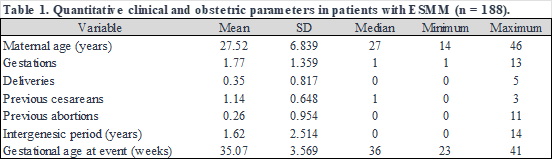
Regarding sociodemographic characteristics, participants' age showed a median of 27 years (mean: 27.52 ± 6.83 years; range: 14 to 46 years). In relation to marital status, 44% (n=82) were married, 43% (n=80) lived in a cohabitating union, and 12% (n=22) were single. In educational attainment, 27% (n=51) reported completed bachelor's degrees, 24% (n=45) completed high school, and 15% (n=28) completed middle school. Regarding employment status, 41% (n=76) had paid employment, 39% (n=73) were exclusively dedicated to homemaking, and 16% (n=30) were students.
In the obstetric domain, the median number of pregnancies was 1 (mean: 1.77 ± 1.35; range: 1 to 13). The median number of deliveries was 0 (maximum 5), previous cesareans’ median of 1 (maximum 3), and abortions median of 0 (maximum 11). The median gestational age at the time of complication was 36 weeks (mean: 35.07 ± 3.56; range: 23 to 41 weeks). 100% (n=188) of patients had prenatal care qualified as adequate (≥5 visits).
The presence of prior comorbidities was documented in 26% (n=48) of cases. Obesity was the primary metabolic disorder (19%, n=36), followed by diabetes mellitus in 4% (n=8), venous thromboembolic disease in 2% (n=3), and nephropathy in 1% (n=1); 74% (n=140) had no documented comorbidity. Likewise, 12% (n=23) presented a history of severe maternal morbidity in previous pregnancies.
The etiological breakdown placed severe preeclampsia as the leading cause of ESMM in 62% (n=117) of the population, followed by hypovolemic shock in 20% (n=38), eclampsia in 13% (n=25), and septic shock in 4% (n=8). Hypertensive disorders accounted for 75% of admissions.
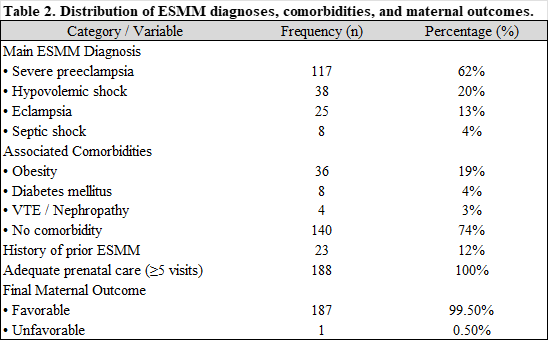
Regarding obstetric resolution, the surgical route (cesarean section) was used in 89% (n=167) of cases, and vaginal delivery in 11% (n=21). The maternal clinical outcome was favorable in 99.5% (n=187). Among neonates, 97% (n=183) were born alive, with a 3% (n=5) perinatal mortality rate. Due to acute maternal compromise and associated prematurity, 54% (n=102) of newborns required admission to the Neonatal Intensive Care Unit (NICU).
DISCUSSION
The findings of this study confirm that hypertensive disorders of pregnancy continue to rank as the primary etiology of extremely severe maternal morbidity in the region (75% combining severe preeclampsia 62% and eclampsia 13%), followed by massive obstetric hemorrhage resulting in hypovolemic shock (20%) and sepsis (4%) 1, 2, 12. These results align with evidence described by Heitkamp et al.18 and Drechsel et al.21, where severe preeclampsia and eclampsia constituted between 50% and 80% of critical obstetric admissions.
In international medical literature (Ben-Ayoun et al., Ibrahim Sous et al.), a direct relationship between maternal age extremes (especially age over 35) and the development of severe events has been reported 13, 14. However, in the present series, the median age was 27 years (mean of 27.52 ± 6.83 years), showing that life-threatening complications predominantly presented in the age group with the highest fertility.
A finding of notable clinical and operational relevance is that 100% of patients had institutional prenatal care considered adequate in terms of visit count (five or more visits) 12. This contrasts sharply with studies such as Wasim et al. in Pakistan, where 62.5% of extreme morbidity cases lacked regular prenatal care 20. This demonstrates that numerical sufficiency of visits alone is insufficient to anticipate fulminant progression cases such as severe preeclampsia or hypovolemic shock; prenatal care needs to be reoriented toward early biophysical and biochemical screening for preeclampsia and strict monitoring of high-risk patients.
The high rate of resolution via cesarean section (89%) reflects the urgency of terminating pregnancy given hemodynamic instability and maternal-fetal compromise, a finding consistent with reports by Blanc et al. and Nik Hazlina et al. 8, 9, 23. Although favorable maternal outcome reached 99.5% thanks to specialized inpatient management, the perinatal cost was high: 54% of newborns required NICU management due to prematurity and perinatal asphyxia.16, 21
REFERENCES
1. Boghossian NS, Greenberg LT, Buzas JS, et al. Severe maternal morbidity from pregnancy through 1 year postpartum. Am J Obstet Gynecol MFM. 2024;6(7):101385. doi:10.1016/j.ajogmf.2024.101385
2. Dakin A, Clinton S, Sloan J, Dicker P, Byrne BM. Severe maternal morbidity trends over 20 years in a tertiary referral stand-alone maternity unit. Eur J Obstet Gynecol Reprod Biol. 2023;283:136-140. doi:10.1016/j.ejogrb.2023.02.009
3. Salahuddin M, Mandell DJ, Lakey DL, et al. Maternal comorbidity index and severe maternal morbidity during delivery hospitalizations in Texas, 2011-2014. Birth. 2020;47(1):89-97. doi:10.1111/birt.12465
4. Organización Mundial de la Salud. Mortalidad materna. Ginebra: OMS; 2023. Disponible en: https://www.who.int/es/news-room/fact-sheets/detail/maternal-mortality
5. Sienas L, Albright CM, Walker S, Hitti J. Severe Maternal Morbidity Associated with Hospital NICU Level in Washington State. Am J Perinatol. 2021;38(13):1335-1340. doi:10.1055/s-0041-1732452
6. Matas JL, Mitchell LE, Sharma SV, Louis JM, Salemi JL. Severe maternal morbidity at delivery and postpartum readmission in the United States. Paediatr Perinat Epidemiol. 2021;35(6):627-634. doi:10.1111/ppe.12762
7. Cuesta-Galindo MG, Bravo-Aguirre DE, Serna-Vela FJ, et al. Analysis of Extreme Maternal Morbidity at the Women´s Hospital of Aguascalientes. Cureus. 2021;13(7):e16145. doi:10.7759/cureus.16145
8. Blanc J, Rességuier N, Loundou A, et al. Severe maternal morbidity in preterm cesarean delivery: A systematic review and meta-analysis. Eur J Obstet Gynecol Reprod Biol. 2021;261:116-123. doi:10.1016/j.ejogrb.2021.04.022
9. Nik Hazlina NH, Norhayati MN, Shaiful Bahari I, Mohamed Kamil HR. The Prevalence and Risk Factors for Severe Maternal Morbidities: A Systematic Review and Meta-Analysis. Front Med (Lausanne). 2022;9:861028. doi:10.3389/fmed.2022.861028
10. Ayala Quintanilla BP, Taft A, McDonald S, Pollock W, Roque Henriquez JC. Social determinants and exposure to intimate partner violence in women with severe acute maternal morbidity in the intensive care unit: a systematic review. BMC Pregnancy Childbirth. 2023;23(1):656. doi:10.1186/s12884-023-05927-5
11. Domingues RMSM, Dias MAB, Nakamura-Pereira M, et al. Perinatal mortality, severe maternal morbidity and maternal near miss: protocol of a study integrated with the Birth in Brazil II survey. Cad Saude Publica. 2024;40(4):e00248222. doi:10.1590/0102-311XPT248222
12. Secretaría de Salud. Informes Semanales para la Vigilancia Epidemiológica de Morbilidad Materna Extremadamente Grave 2024. Ciudad de México: DGE; 2024.
13. Ben-Ayoun D, Walfisch A, Wainstock T, Sheiner E, Imterat M. Trend and risk factors for severe peripartum maternal morbidity - a population-based cohort study. Matern Child Health J. 2023;27(4):719-727. doi:10.1007/s10995-022-03568-2
14. Ibrahim Sous C, Moravec W, DeFranco E, Kelly EA, Rossi RM. Factors Associated with Maternal Morbidity among Black Women in the United States. Am J Perinatol. 2024;41(15):2063-2071. doi:10.1055/a-2295-4058
15. Auger N, Ukah UV, Wei SQ, Healy-Profitós J, Lo E, Dayan N. Impact of Covid-19 on risk of severe maternal morbidity. Crit Care. 2023;27(1):344. doi:10.1186/s13054-023-04584-6
16. Kilpatrick SJ, Abreo A, Gould J, Greene N, Main EK. Confirmed severe maternal morbidity is associated with high rate of preterm delivery. Am J Obstet Gynecol. 2016;215(2):233.e1-233.e2337. doi:10.1016/j.ajog.2016.02.026
17. Kulkarni R, Kshirsagar H, Begum S, Patil A, Chauhan S. Maternal near miss events in India. Indian J Med Res. 2021;154(4):573-582. doi:10.4103/ijmr.IJMR_928_19
18. Heitkamp A, Meulenbroek A, van Roosmalen J, et al. Maternal mortality: near-miss events in middle-income countries, a systematic review. Bull World Health Organ. 2021;99(10):693-707F. doi:10.2471/BLT.21.285945
19. Heitkamp A, Suh J, Gebhardt S, et al. Every maternal near-miss counts: Need for a national audit in South Africa? A mixed-methods study. S Afr Med J. 2022;112(9):769-777. doi:10.7196/SAMJ.2022.v112.i9.16248
20. Wasim T, Raana GE, Wasim M, Mushtaq J, Amin Z, Asghar S. Maternal near-miss, mortality and their correlates at a tertiary care hospital. J Pak Med Assoc. 2021;71(7):1843-1848. doi:10.47391/JPMA.05-678
21. Drechsel KCE, Adu-Bonsaffoh K, Olde Loohuis KM, et al. Maternal near-miss and mortality associated with hypertensive disorders of pregnancy remote from term: a multicenter observational study in Ghana. AJOG Glob Rep. 2022;2(2):100045. doi:10.1016/j.xagr.2021.100045
22. Firoz T, Trigo Romero CL, Leung C, Souza JP, Tunçalp Ö. Global and regional estimates of maternal near miss: a systematic review, meta-analysis and experiences with application. BMJ Glob Health. 2022;7(4):e007077. doi:10.1136/bmjgh-2021-007077
23. Nik Hazlina NH, Norhayati MN, Shaiful Bahari I, Mohamed Kamil HR. The Prevalence and Risk Factors for Severe Maternal Morbidities: A Systematic Review and Meta-Analysis. Front Med (Lausanne). 2022;9:861028. doi:10.3389/fmed.2022.861028
Citation
García de León-Carreón PP, Medina-Valdez ME, Félix-Heredia JL, Bojorquez-Olguin A. Epidemiological Profile of Patients with Severe Maternal Morbidity in a Second-Level Hospital in Sinaloa (2021–2024). ERSJ 2026,2(2) 110-118
Academic Editor: Porfirio Felipe Hernández Bautista, Received: September-22-2026, Revised: October-01-2026, Accepted: October-01-2026, Published: October-18-2026.