Association Between Marginalization Degree and Congenital Syphilis Confirmation Among Probable Cases Reported in a Hospital in Ciudad Obregón, 2019–2024
Eduardo Alvarado-Acosta and Carmen Alicia Ruiz-Valdez
Instituto Mexicano del Seguro Social. Hospital General Regional No.1, Av. Vicente Guerrero, Bellavista, 85110, Obregón, Sonora, México
Abstract
Introduction: Congenital syphilis remains a major public health challenge. Although it is usually associated with adverse socio-spatial determinants, its diagnostic confirmation within hospital cohorts of suspected cases may exhibit patterns distinct from those assumed at the population level.Objetive: To determine the association between the degree of socio-spatial marginalization and the diagnostic confirmation of congenital syphilis among probable cases reported to the Epidemiology Department of the Hospital General Regional No. 1 in Ciudad Obregón, Sonora, during the 2019–2024 period.
Materials and methods: An observational, analytical, cross-sectional, and retrospective study. The study population consisted of all 95 notifications of probable cases of congenital syphilis registered in the Hospital Epidemiological Surveillance Unit (2019–2024). Regulatory criteria defined 42 confirmed cases and 53 discarded cases. The maternal address was geocoded by assigning the degree of marginalization by neighborhood (colonia, CONAPO 2020), which was dichotomized into medium to very high marginalization versus very low to low marginalization. Statistical analysis included the median and interquartile range (IQR) for maternal age, Mann–Whitney U test, Fisher's exact test, and odds ratio (OR) with a 95% confidence interval (95% CI).
Results: Of 95 evaluated notifications, 42 cases were confirmed (44.2%) and 53 were discarded (55.8%). The median maternal age was 24.5 years (IQR: 20–29) in confirmed cases and 25.0 years (IQR: 21–30) in discarded cases (p = 0.879). Among confirmed cases, 69.0% (n = 29/42) were asymptomatic at birth. Regarding maternal occupation in confirmed cases: 42.9% (n = 18/42) were employed, 40.5% (n = 17/42) were homemakers, 7.1% (n = 3/42) were students, and 9.5% (n = 4/42) were engaged in other activities. Additionally, 66.7% (n = 28/42) of mothers of confirmed cases resided in areas of very low or low marginalization, and 33.3% (n = 14/42) in medium to very high marginalization. In the 2×2 contingency table, the confirmation rate was 56.0% (14/25) in medium-to-very-high marginalization versus 40.0% (28/70) in low-to-very-low marginalization (OR = 1.91, 95% CI: 0.76–4.79; Fisher's exact test, p = 0.237; uncorrected chi-square, OR = 2.15, 95% CI: 0.83–5.50).
Conclusions: Among the reported probable cases, no statistically significant association was observed between the degree of territorial marginalization and the likelihood of congenital syphilis confirmation. The wide confidence interval reflects sample imprecision due to low statistical power. Given the high percentage of asymptomatic newborns, universal prenatal and postpartum serological screening must be maintained without segmentation by apparent vulnerability profiles.
Keywords: Congenital syphilis, marginalization, screening, epidemiological surveillance.
INTRODUCTION
Syphilis is a systemic and chronic bacterial infection caused by Treponema pallidum subspecies pallidum. 1, 2 Its primary transmission mechanism is sexual contact through breaks in the skin or mucous membranes. 2, 3 In pregnant women, the spirochete can be transmitted via the hematogenous transplacental route to the fetus in any trimester of pregnancy, or through direct contact during delivery with active maternal genital lesions. 1, 4 In the absence of timely diagnosis and treatment with penicillin, gestational syphilis leads to severe adverse pregnancy outcomes in up to 50% to 70% of pregnancies, such as spontaneous abortion, stillbirth, preterm delivery, intrauterine growth restriction, and congenital syphilis. 1, 4, 5
Although benzathine penicillin administered in early stages of pregnancy exhibits a preventive efficacy exceeding 98% 1, 4, the Region of the Americas has experienced an alarming resurgence over the past decade, with regional congenital syphilis rates exceeding 4 cases per 1,000 live births, moving away from the international elimination target of ≤0.5 cases per 1,000 live births established by the Pan American Health Organization (PAHO). 6, 7 In Mexico, the National Epidemiological Surveillance System has documented a sustained increase in notifications, with the state of Sonora ranking among the jurisdictions with the highest reported incidence 8, 9.
Several investigations conceptualize socio-spatial marginalization as a structural determinant of health disparities, linking the lack of services and material resources to barriers in access to prenatal care and delayed diagnoses. 10, 11 However, most of the literature evaluates population-based ecological correlations rather than the probability of confirmation within hospital surveillance systems of probable cases. In a formal social security institution—where users hold healthcare affiliation—the factors conditioning whether a probable case is ruled as confirmed may differ from general community incidence rates.
Therefore, the objective of the present study was to determine the association between the degree of socio-spatial marginalization of maternal residence and the diagnostic confirmation of congenital syphilis among probable cases reported to the Epidemiology Department of the Hospital General Regional No. 1 in Ciudad Obregón, Sonora, during the 2019–2024 six-year period.
MATERIALS AND METHODS
An observational, analytical, cross-sectional, and retrospective study was conducted at the Epidemiology Department and the Hospital Epidemiological Surveillance Unit (UVEH) of the Hospital General Regional No. 1 (HGR 1) of the Mexican Social Security Institute (IMSS) in Ciudad Obregón, Sonora, from January 1, 2019, to December 31, 2024. The study population comprised all notifications formally registered in the nominal census of probable cases of congenital syphilis.
Inclusion flow diagram: During the 2019–2024 period, 98 initial nominal records were identified in the surveillance censuses. Of these, 3 records were excluded: 2 due to duplicate registration numbers and 1 due to a medical record with complete omission of the maternal address, which prevented georeferencing. There were no losses due to a lack of final epidemiological ruling. Consequently, the final analyzed cohort was composed of 95 notifications of probable congenital syphilis cases (42 confirmed and 53 discarded).
Classification was performed in accordance with the regulatory guidelines of the Manual de Procedimientos Estandarizados para la Vigilancia Epidemiológica de Sífilis Congénita from the Directorate General of Epidemiology (DGE) of the Ministry of Health of Mexico 12:
Probable case: Any newborn or stillborn infant of a mother with serological evidence of syphilis (reactive treponemal or non-treponemal test during pregnancy, delivery, or puerperium) who did not receive adequate treatment or whose treatment was not documented, or any neonate with suggestive clinical signs.
Confirmed case: Any probable case meeting at least one of the following criteria:
Identification of T. pallidum by darkfield microscopy, immunofluorescence, or PCR in lesions, placenta, umbilical cord, or autopsy.
Demonstration of non-treponemal serological titers (VDRL/RPR) in neonatal peripheral serum fourfold higher (two dilutions higher) than maternal titers at delivery.
Presence of clinical manifestations at birth (hepatosplenomegaly, osteochondritis on X-rays, palmoplantar pemphigus, serosanguinous rhinitis, neurosyphilis) in an infant of a mother with reactive serology who had inadequate, null, or treatment administered <30 days prior to obstetric resolution.
Persistence or increase in treponemal/non-treponemal serological titers after 6 months of life.
• Discarded case: A probable case in which timely and adequate maternal treatment was demonstrated (>30 days before delivery with benzathine penicillin at the correct dose), neonatal non-treponemal serological titers were lower than maternal titers (or non-reactive), clinical/paraclinical signs were absent, and seroreversion occurred during follow-up.
Variables and geocoding
Dependent variable: Diagnostic confirmation of congenital syphilis (dichotomous: confirmed vs. discarded).
Primary independent variable: Degree of urban socio-spatial marginalization. Obtained from the residential address recorded on the epidemiological study sheet and maternal clinical history. The geographic linking unit was the urban neighborhood (colonia) or residential locality. It was geocoded through the National Population Council platform (CONAPO, 2020) 13, assigning the corresponding urban marginalization index across its 5 original categories (very low, low, medium, high, very high). For the analytical 2×2 model, the grouping was pre-specified into two vulnerability strata: lower marginalization stratum (very low and low) versus higher marginalization stratum (medium, high, and very high). Geocoding was achieved in 98.9% of eligible records (95/96).
Covariates: Maternal age (completed years), maternal occupation, marital status, timing of gestational syphilis screening/diagnosis (formally defined as the trimester of maternal serological diagnostic capture: first trimester ≤13 weeks, second trimester 14–27 weeks, third trimester ≥28 weeks/delivery; untreated serological antecedents prior to pregnancy were reclassified according to the first confirmed reactive serology in the current pregnancy), and presence of clinical symptoms in the newborn at the time of neonatal evaluation.
Continuous variables were evaluated using the Shapiro–Wilk goodness-of-fit test to verify normal distribution. Upon finding skewness in maternal age distribution, it was summarized as median and interquartile range (IQR; 25th percentile – 75th percentile) and compared between groups using the non-parametric Mann–Whitney U test. Qualitative variables were expressed as absolute and relative frequencies (percentages with explicit numerators and denominators).
To examine the association between marginalization and diagnostic confirmation, a 2×2 contingency table was constructed. Expected cell frequencies were calculated. Because there were cells with small counts in the high marginalization strata, Fisher's exact test was used to contrast the hypothesis of independence, additionally reporting Pearson’s chi-square statistic with and without Yates’ continuity correction. The strength of association was estimated using the odds ratio (OR) with its respective 95% confidence interval (95% CI). The significance level was set at p < 0.05. Analyses were conducted using SPSS version 25 and Epi Info version 7.2.
The protocol was approved by the Local Health Research and Research Ethics Committee of HGR No. 1 (IMSS) with a waiver of informed consent, as it was a retrospective analysis of secondary epidemiological surveillance sources without risk to patients, safeguarding confidentiality in accordance with the Declaration of Helsinki and Mexican standard NOM-012-SSA3-2012.
RESULTS
A total of 95 notifications of probable congenital syphilis cases recorded between 2019 and 2024 were analyzed. Of these, 42 were judged as confirmed cases (44.2%) and 53 as discarded cases (55.8%).
Sociodemographic and clinical maternal-neonatal characteristics
Maternal age ranged from 15 to 43 years, with a mean of 25.0 ± 5.5 years. Due to non-normality (Shapiro–Wilk, p < 0.01), the overall median was 25.0 years (IQR: 20.0–30.0). Stratified by ruling, the median age in mothers of confirmed cases was 24.5 years (IQR: 20.0–29.0), while in discarded cases it was 25.0 years (IQR: 21.0–30.0), without statistically significant differences (Mann–Whitney U = 1098.5; p = 0.879).
Regarding maternal occupation among mothers of confirmed newborns (n = 42), 42.9% (n = 18/42) were employed in the formal/commercial sector, 40.5% (n = 17/42) performed unpaid domestic work, 7.1% (n = 3/42) were students, and 9.5% (n = 4/42) reported other activities (informal sales or health services). Regarding marital status among mothers with confirmed cases, 59.5% (n = 25/42) were in a common-law union, 21.4% (n = 9/42) were single, and 19.1% (n = 8/42) were married.
Concerning the timing of maternal screening and diagnosis across the total cohort of 95 notifications, 35.8% (n = 34/95) were diagnosed in the third trimester or during delivery, 33.7% (n = 32/95) in the first trimester, and 30.5% (n = 29/95) in the second trimester. The distribution of the diagnostic capture trimester showed no statistically significant association with neonatal confirmation (χ² = 3.484, df = 2, p = 0.175).
In the 42 confirmed newborns, 69.0% (n = 29/42) were completely asymptomatic in the immediate neonatal period and were detected exclusively by serology and a history of inadequate maternal treatment, whereas 31.0% (n = 13/42) presented compatible signs at birth (hepatosplenomegaly, prematurity, jaundice, and skin lesions). Purely on an exploratory and descriptive level, births of confirmed cases occurred across all months of the year (range: 2 to 5 cases per month), with discrete counts of 5 cases (11.9%) observed in June, August, September, and October, and 2 cases (4.8%) in November, a pattern that reflects random fluctuations inherent to hospital sample size without evidence of seasonality.
Association between degree of marginalization and diagnostic confirmation
The distribution of the 95 probable cases according to the five CONAPO marginalization categories at the maternal address was: very low in 27.4% (n = 26/95; 11 confirmed and 15 discarded), low in 46.3% (n = 44/95; 17 confirmed and 27 discarded), medium in 17.9% (n = 17/95; 9 confirmed and 8 discarded), high in 5.3% (n = 5/95; 3 confirmed and 2 discarded), and very high in 3.1% (n = 3/95; 2 confirmed and 1 discarded). In confirmed cases, 66.7% (n = 28/42) came from areas of very low or low marginalization.
For analytical hypothesis testing, the pre-specified grouping into two strata was applied: medium to very high marginalization versus very low to low marginalization. The corresponding 2×2 table is detailed below:
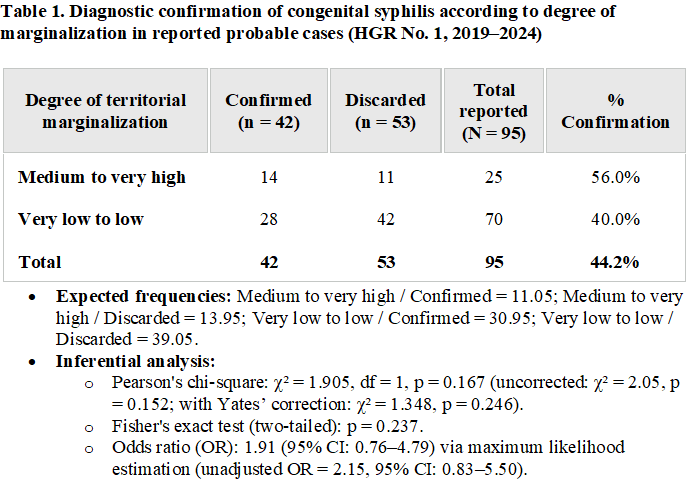
Although the confirmation rate was proportionally higher in newborns born to mothers residing in neighborhoods with medium to very high marginalization (56.0% vs. 40.0%), the difference did not reach statistical significance. The wide confidence interval obtained (0.76–4.79 / 0.83–5.50) indicates marked estimation imprecision conditioned by the small number of events in higher vulnerability categories, making the data compatible with both a moderate reduction (OR < 1) and a substantial increase (OR > 5) in confirmation probability.
DISCUSSION
The present study evaluated the relationship between the degree of territorial marginalization of maternal residence and the diagnostic confirmation of congenital syphilis in a hospital cohort of probable cases reported over a six-year period. When contextualizing the results, it is imperative to emphasize that the design did not measure the community population-wide incidence or prevalence of the infection—as live birth denominators by municipal socioeconomic stratum were not available—but rather the conditional probability that a newborn already entering the surveillance system under epidemiological suspicion would ultimately be adjudicated as a confirmed case.
Within this framework, two-thirds (66.7%) of confirmed cases resided in urban neighborhoods classified as having low or very low marginalization. Upon collapsing categories, inferential analysis yielded an OR of 2.15 (95% CI: 0.83–5.50; Fisher's exact test p = 0.237). This finding should not be interpreted as evidence of equivalence or absolute absence of association, but rather as a reflection of statistical imprecision linked to sample size and scarce events in high-marginalization strata. Such wide intervals harbor plausibility for both a neutral or discretely protective effect and an increase of more than fivefold in confirmation risk, warranting caution to avoid a Type II error.
The concentration of cases in low-marginalization neighborhoods is consistent with the operational characteristics of the IMSS in Ciudad Obregón, where the insured population is primarily linked to formal urban employment. Studies in populations with social security have documented that geographic accessibility and institutional affiliation biases may over-represent consolidated urban sectors, whereas populations in extreme marginalization or peripheral rural areas might face greater barriers to transport, screening, and timely notification. 11, 14
Furthermore, it was observed that nearly seven out of ten confirmed newborns (69.0%) were asymptomatic at birth. This figure is fully concordant with international reviews specialized in early congenital syphilis 1, 4, 15 , which warn that the absence of clinical stigmata on neonatal physical examination is the rule rather than the exception. This silent presentation reinforces the regulatory mandate to maintain standardized peripheral blood serological screening for every woman in labor or immediate puerperium prior to hospital discharge, regardless of apparent socioeconomic status or absence of signs. 12, 16
In the sociodemographic analysis, a high proportion of single mothers or mothers in common-law union was observed (80.9% combined). Although authors such as Benítez et al. 17 and Matthias et al. 3 have explored psychosocial vulnerability in pregnant women with syphilis, it must be clarified that marital status per se does not allow concluding the existence of dysfunctional or "fragile" family support networks, as this qualitative variable was not evaluated in our instrument and such extrapolation would be unfounded and potentially stigmatizing. Similarly, although the lack of concurrent treatment of the male partner is a documented cause of recurrent gestational reinfection in international literature 3, 18 , our series lacked systematic records regarding contact management or partner therapeutic adherence; hence, this factor can only be posed as a healthcare hypothesis pending local quantification.
Study limitations
The study presents substantial methodological limitations:
• Selection bias: The sample was restricted to cases reported in a single secondary-care hospital assigned to the ordinary scheme, excluding uninsured populations or those treated in rural health clinics and Ministry of Health/IMSS-Bienestar hospitals.
• Ecological fallacy and address classification: The assigned degree of marginalization corresponded to an aggregate territorial index (neighborhood/locality according to CONAPO 2020) and not an individual household socioeconomic level. It is feasible that low-income families reside in urban sectors classified with low overall marginalization (or vice versa), inducing non-differential misclassification error.
• Unmeasured confounding variables: Granular and complete information was not available in surveillance records regarding key determinants: number of and adherence to prenatal care visits, timeliness and complete regimen of maternal benzathine penicillin (dose and time prior to delivery), quantitative maternal follow-up serological titers, and history of reinfection.
• Low statistical power: The small number of births in the high (n = 5) and very high (n = 3) marginalization strata limited the power of multivariable analyses and prevented uncollapsed, disaggregated stratification.
Among newborns notified as probable cases of congenital syphilis at the host hospital, the confirmation probability showed no statistically significant association with the degree of socio-spatial marginalization of maternal residence, with cases predominantly originating from areas of low and very low urban marginalization. However, imprecision in risk estimates precludes ruling out a clinically relevant effect. Given that more than two-thirds of confirmed neonates were clinically asymptomatic, hospital universal serological screening policies must be strictly enforced during prenatal and peripartum care without relaxing suspicion based on socioeconomic or geographic strata.
REFERENCES
1. Fang J, Partridge E, Bautista G, Sankaran D. Congenital Syphilis Epidemiology, Prevention, and Management in the United States: A 2022 Update. Cureus. 2022; 14(12):e33009.
2. Peeling RW, Mabey D, Kamb ML, Chen XS, Radolf JD, Benzaken AS. Syphilis. Nat Rev Dis Primers. 2017; 3:17073.
3. Matthias JM, Spencer EC, Bowen VB, Peterman TA. Exploring changes in maternal and congenital syphilis epidemiology to identify factors contributing to increases in congenital syphilis in Florida: a two time-period observational study (2013–2014 vs 2018–2019). BMJ Open. 2022; 12(9):e065348.
4. Sankaran D, Partridge E, Lakshminrusimha S. Congenital Syphilis—An Illustrative Review. Children (Basel). 2023; 10(8):1310.
5. Qin J, Yang T, Xiao S, Tan H, Feng T, Fu H. Reported estimates of adverse pregnancy outcomes among women with and without syphilis: a systematic review and meta-analysis. PLoS One. 2014; 9(7):e102203.
6. Pan American Health Organization. Syphilis cases increase in the Americas. Washington, D.C.: PAHO; 2024.
7. World Health Organization. Global guidance on criteria and processes for validation: elimination of mother-to-child transmission of HIV, syphilis and hepatitis B virus. Geneva: WHO; 2021.
8. Dirección General de Epidemiología. Boletín Epidemiológico Sistema Nacional de Vigilancia Epidemiológica. Sistema Único de Información. Semana 52. México: Secretaría de Salud; 2024.
9. Servicios de Salud de Sonora. Panorama Epidemiológico de la Sífilis Congénita en el Distrito de Salud 04 de Sonora. Hermosillo: Secretaría de Salud de Sonora; 2024.
10. Baah FO, Teitelman AM, Riegel B. Marginalization: Conceptualizing patient vulnerabilities in the framework of social determinants of health—An integrative review. Nurs Inq. 2019; 26(1):e12268.
11. David A, Posfay-Barbe KM, Aguiar-Nogueira C, Toutous-Trellu L. Congenital syphilis in Switzerland: a marker of inequality? A mini-review. Front Public Health. 2023; 11:1265725.
12. Dirección General de Epidemiología. Manual de Procedimientos Estandarizados para la Vigilancia Epidemiológica de Sífilis Congénita. México: Secretaría de Salud; 2021.
13. Consejo Nacional de Población. Índices de marginación 2020 urbana y por colonia. México: CONAPO; 2021.
14. Instituto Nacional de Salud Pública. Equidad en el acceso a los servicios de salud y cobertura institucional en México. Cuernavaca: INSP; 2021.
15. Wozniak PS, Cantey JB, Zeray F, Leos NK, Sheffield JS, Wendel GD, Sánchez PJ. Congenital syphilis in neonates with nonreactive nontreponemal test results. J Perinatol. 2017; 37(10):1108-1112.
16. Secretaría de Salud. Norma Oficial Mexicana NOM-007-SSA2-2016, Para la atención de la mujer durante el embarazo, parto y puerperio, y de la persona recién nacida. México: Diario Oficial de la Federación; 2016.
17. Benítez J, Yépez MA, Hernández-Carrillo M, Martínez DM, Cubides-Munévar Á, Holguín-Ruiz JA, et al. Sociodemographic and clinical characteristics of gestational syphilis in Cali, 2018. Biomédica. 2021; 41(Suppl. 2):140-150.
18. Workowski KA, Bachmann LH, Chan PA, Johnston CM, Muzny CA, Park I, et al. Sexually Transmitted Infections Treatment Guidelines, 2021. MMWR Recomm Rep. 2021; 70(4):1-187.
Citation
Alvarado-Acosta E and Ruiz-Valdez CA, Association between the degree of marginalization and congenital syphilis, ERSJ 2026,2(2) 76-86
AAcademic editor: Mónica Grisel Rivera-Mahey Received: April-24- 2026 Revised: September-22- 2026 Accepted: September-29- 2026 Published: October-18-2026