Mortality from rickettsiosis related to therapeutic management
Freddy Gerardo Lucatero-Castillo, Jesús Mendoza-Cazares, Porfirio Felipe Hernández-Bautista*
*Coordinación de Calidad de Insumos y Laboratorios Especializados, Instituto Mexicano del Seguro Social, Ciudad de México 07760, México.
Abstract
Introduction: Rickettsiosis is an intracellular bacterial disease transmitted by arthropods, endemic to several Mexican states. It causes fever, rash, and skin lesions. Although usually mild, conditions such as spotted fever can be fatal. Early diagnosis and prompt treatment with doxycycline or chloramphenicol are crucial to reducing mortality.Objetive: To determine mortality and factors associate rickettsiosis in northwestern Mexico.
Materials and methods: A retrospective cohort study, it took all information rickettsiosis cases, which are in the nominal list of the health jurisdiction IV of Sonora, Mexico. The information was collected from medical records, to integrate the database. We performed a descriptive and inferential statistical analysis to detect the frequency and factors associated with rickettsial diseases.
Results: A total of 225 patients with a diagnosis of rickettsiosis, finding a total of 25 deaths, with a mortality of 11%. The risk factors presented were ≤ 5 years of age (RR, 7.22, 95% CI, 3.78-13.81), the time interval between the start of treatment and the onset of symptoms> 5 days (RR, 2.42; 95% CI, 0.96-6.35), use of trimethoprim-sulfamethoxazole (RR, 2.65, 95% CI, 0.93-7.52), chloramphenicol (RR, 9.07, 95% CI, 4.68-17.56), gamma globulin (RR, 9.7; 95% CI, 5.19-17.79), corticosteroids (RR, 12; 95% CI, 6.05-23.77) and use of doxycycline (RR, 0.14, 95% CI, .07 to .29).
Conclusions: We present a high mortality, and major associated factors are age less than 5 years, an interval of time between the start of treatment and the onset of symptoms more than five days, the use of trimethoprim-sulfamethoxazole, chloramphenicol and corticosteroids. Doxycycline therapy reduced mortality.
Keywords: Rickettsiosis, clinical symptoms, treatment.
INTRODUCTION
Rickettsiosis is an infectious disease caused by *Rickettsia* species, which are obligate intracellular bacteria closely associated with arthropod vectors. The disease is transmitted to humans primarily through the bite of infected ticks (CDC: [http://www.cdc.gov/rmsf/index.html]. In Mexico, rickettsial diseases are endemic to several states, including Sinaloa, Jalisco, Nuevo León, and Coahuila. Since 1985, annual reports have documented the coexistence of different rickettsial infections, including endemic typhus, epidemic typhus, and spotted fevers.1,2
Patients with rickettsiosis typically present with a maculopapular rash, petechiae, or an eschar at the site of the tick bite. While many *Rickettsia* species cause mild to moderate illness, epidemic typhus and Rocky Mountain spotted fever (RMSF) can progress to severe, life-threatening clinical presentations if left untreated.3
Timely treatment is critical and must be administered as early as possible to prevent complications or death. Doxycycline is the gold-standard, first-line treatment for adults and children of all ages, and it should be initiated immediately upon clinical suspicion of RMSF. The use of alternative antibiotics is associated with a significantly higher risk of fatal outcomes. Treatment is most effective at preventing mortality if doxycycline is started within the first five days of symptom onset (CDC: [http://www.cdc.gov/rmsf /symptoms/index.html].4
Epidemiological data in Mexico vary by region. A seroprevalence study in Yucatan evaluated 390 people and found that only 22 individuals (5.6%) were reactive to rickettsial antibodies. In contrast, a study conducting a clinical review of pediatric cases at the Children's Hospital of the State of Sonora reported that all evaluated patients presented with fever and a petechial rash. Laboratory abnormalities in that cohort included elevated liver enzymes, hyponatremia, and thrombocytopenia; despite treatment with doxycycline and chloramphenicol, a mortality rate of 22% was observed.5,6,7,8
Furthermore, data from the National Epidemiological Surveillance System in Mexico indicated that from 2007 to 2009, 25 states reported a combined total of 278 cases, with a case-fatality rate of 2.8%. While early treatment with doxycycline has consistently demonstrated a survival advantage in RMSF cases, it remains unclear whether co-administration with immunomodulators improves survival outcomes during the early stages of the disease.9,10
In Northwest Mexico, RMSF has become a major public health concern. Evolving climatic conditions favor vector proliferation, leading to an increased disease burden and high mortality rates. Therefore, we conducted this retrospective cohort study to determine the specific factors associated with mortality in the southern region of the State of Sonora.
MATERIALS AND METHODS
We conducted a retrospective cohort study from January 2008 to December 2011 within the Yaqui Valley Jurisdiction IV in Sonora, Mexico. We included patients with a confirmed diagnosis of RMSF, defined by the detection of IgM antibodies via indirect immunofluorescence assay (IFA). All diagnostic samples were processed at the State Laboratory of Public Health in Sonora, Mexico.
The primary outcome of interest was patient mortality. To account for early mortality—where patients succumbed to the illness before antibody titers could reach detectable peaks—clinical and epidemiological judgment was applied. These early-fatal cases were reviewed and formally classified by a panel of medical experts to ensure diagnostic accuracy.
Data were extracted from medical records and included epidemiological history (such as documented tick exposure), sociodemographic characteristics (age and gender), and hospital admission details. Clinical data collected encompassed the presence of fever, myalgia, arthralgia, rash, and the exact date of symptom onset. Regarding therapeutic management, we recorded data on all administered drugs, specifically tracking the use of doxycycline, chloramphenicol, trimethoprim-sulfamethoxazole (TMP-SMX), human immunoglobulin (gamma-globulin), and corticosteroids.
Descriptive analysis included the tabulation of all variables, stratified by survival status (survivors vs. deceased), using percentages and Chi-squared tests for categorical comparisons. A crude analysis was performed using univariable Cox regression models to evaluate the direct association between each variable and mortality. Finally, a multivariable Cox proportional hazards model was constructed. All variables of clinical interest were forced into the multivariable model regardless of their univariable significance, as the primary objective was to identify independent predictors of mortality while controlling for confounding factors.
Results are reported as Hazard Ratios (HR)and relative risk accompanied by 95% Confidence Intervals (95% CI). Statistical significance for the regression models was assessed using the Wald test. P-values < 0.05 were considered statistically significant; however, due to the restricted sample size, P-values up to 0.1 were considered marginally significant. Anonymized data were managed in Microsoft Excel and transferred to Epi Info 7 and STATA 11 for statistical processing. This study was approved by the local Bioethics and Research Committee of the Regional General Hospital No. 1 of the Mexican Social Security Institute (IMSS) in Sonora, Mexico.
RESULTS
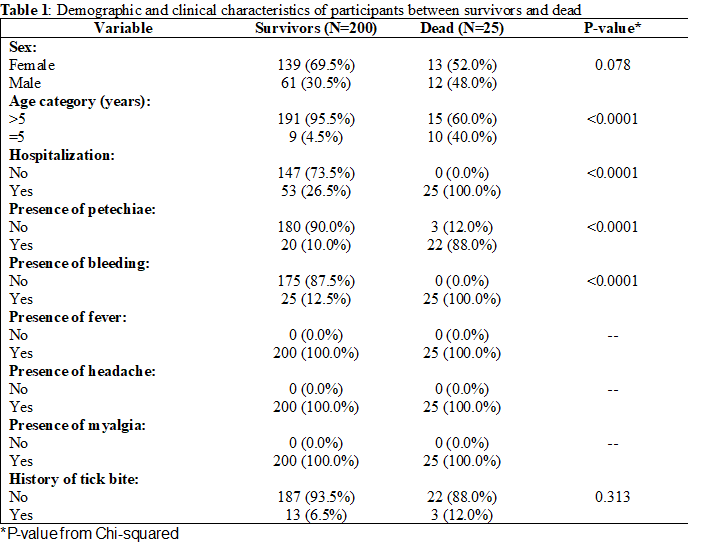
We analyzed data from 225 patients diagnosed with RMSF, which included 25 recorded deaths, representing an 11% case-fatality rate. Age distribution varied significantly: 95.5% of survivors were older than 5 years, compared to only 60% of those who died (p < 0.0001). Regarding gender, 139 (69.5%) survivors and 13 (52%) deceased patients were female, a difference that was only marginally significant (p = 0.078).
Constitutional symptoms such as fever, headache, and myalgia were universal, presenting in 100% of the study population. Conversely, severe clinical signs were heavily concentrated in fatal cases: petechiae occurred in 10% of survivors versus 88% of deaths, and active bleeding was noted in 12.5% of survivors versus 100% of deaths (both comparisons p < 0.0001). A known history of a tick bite was reported by only 3 (12%) deceased patients and 13 (6.5%) survivors (p = 0.3). Hospitalization—serving as a proxy for clinical severity—was required for 100% of the deceased patients compared to 26.5% of survivors (p < 0.0001) (Table 1).
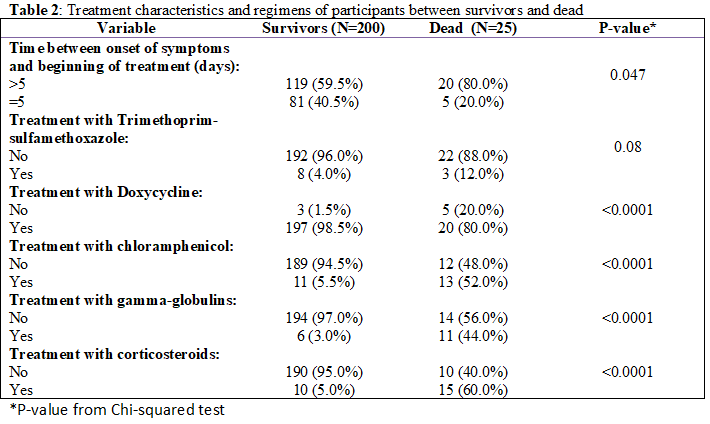
Regarding therapeutic timing, 80% of patients who died initiated treatment more than 5 days after symptom onset, compared to 59.5% of survivors (p = 0.047). The detailed distribution of treatment regimens between groups is presented in Table 2.
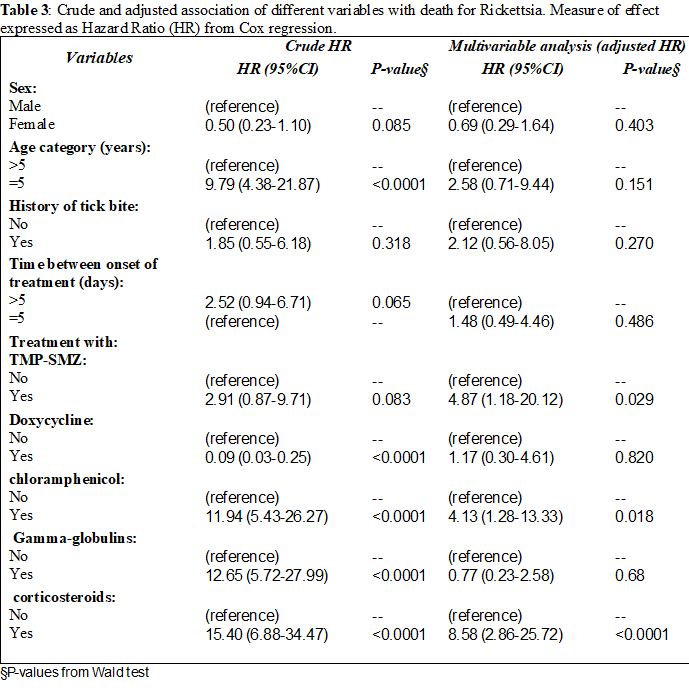
In the univariable (crude) Cox regression model, children aged 5 years or younger exhibited a nearly 10-fold higher hazard of death compared to older participants (p < 0.0001). Female patients demonstrated a lower risk of mortality than males, though this trend was marginally significant (HR = 0.5, p = 0.085). Doxycycline administration demonstrated a strong, statistically significant protective effect (HR = 0.09, 95% CI: 0.03–0.25). Conversely, alternative therapeutic interventions were strongly associated with increased mortality: chloramphenicol (HR = 11.9, p < 0.0001), gamma-globulins (HR = 12.6, p < 0.0001), and corticosteroids (HR = 15.4, p < 0.0001). Trimethoprim-sulfamethoxazole showed a marginal association with fatal outcomes (HR = 2.9, p = 0.08).
In the multivariable Cox regression analysis—which adjusted for all treatment regimens, sex, age, and tick bite history—several crude associations showed evidence of confounding. Younger participants still experienced higher mortality, though it became marginally significant (HR = 2.6, p = 0.15). Treatment with corticosteroids (HR = 8.6, p < 0.0001), chloramphenicol (HR = 4.1, p = 0.018), and trimethoprim-sulfamethoxazole (HR = 4.9, p = 0.03) remained strongly and independently associated with mortality. Notably, for these latter regimens, the adjusted HR was higher and more significant than the crude HR, indicating that the crude analysis was negatively confounded by other covariates. Due to the limited sample size and the high correlation between variables, the protective effect of doxycycline lost its statistical significance in the fully adjusted model (Table 3).
DISCUSSION
Prior literature reports highly variable mortality rates for rickettsial diseases, ranging from 2% to 36%. Our study identified an 11% case-fatality rate, which aligns with these global estimates. Demographically, mortality was heavily skewed toward pediatric patients. Furthermore, 100% of deaths occurred among hospitalized individuals, confirming that baseline clinical severity at presentation is a primary driver of fatal outcomes. These findings mirror those described by Thorner et al. in the United States.11
The most prevalent clinical manifestations in our cohort were headaches, myalgia, arthralgia, and bleeding. Notably, only a minority of patients recalled a history of a tick bite, and this variable showed no statistical association with mortality.12,13,14,15 Our clinical findings contrast with those of Hidalgo et al. in Colombia, where only 8% of patients presented with myalgias and arthralgias.16
The primary risk factors for mortality identified in this study were an age under 5 years, a treatment delay exceeding 5 days from symptom onset, and the utilization of trimethoprim-sulfamethoxazole, chloramphenicol, gamma-globulins, or corticosteroids.17,18,19 Conversely, doxycycline acted as a major protective factor, corroborating the findings of Holman et al..20 The loss of statistical significance for doxycycline in the multivariable analysis is likely an artifact of our small sample size and collinearity with severe cases.
Delayed treatment (beyond 5 days from onset) is a well-established driver of lethality confirmed across multiple endemic regions. However, a key limitation of our observational data is that gamma-globulins and corticosteroids were exclusively administered to hospitalized patients. This indicates a severe selection bias, as these immunomodulators were likely introduced as a desperation measure for critically ill patients rather than acting as a direct cause of death.
Doxycycline remains undisputed as the first-line drug of choice, supported by our univariable finding of an 81% reduction in the hazard of death, proving vastly superior to chloramphenicol. In the adjusted Cox model, the treatments positively associated with mortality were trimethoprim-sulfamethoxazole, chloramphenicol, and corticosteroids. These findings align with current guidelines from the Centers for Disease Control and Prevention (CDC), which warn that the use of antibiotics other than doxycycline for suspected rickettsiosis is associated with an elevated risk of fatal outcomes (CDC: [http://www.cdc.gov/rmsf/symptoms/index.html].21
The primary limitation of our study is its small sample size, which stems from the inherent difficulties of diagnosing RMSF early in the course of the disease. This challenge is compounded by a lack of accessible specialized diagnostic laboratory techniques at the point of care and the highly non-specific early symptoms of the disease. Additionally, missing data within the medical records restricted our ability to fully control other potential clinical confounders.22
This study demonstrates that an associated risk of mortality from RMSF is independently associated with an age under 5 years, a treatment delay of more than five days from symptom onset, and the use of alternative therapies such as trimethoprim-sulfamethoxazole, chloramphenicol, and corticosteroids. Early initiation of doxycycline significantly reduces mortality. The use of gamma-globulin did not retain statistical significance in the multivariable analysis and cannot be definitively classified as a risk or protective factor.23
Recognizing these clinical and therapeutic risk factors is vital to reducing the public health burden of rickettsiosis. Because the early clinical picture is non-specific and laboratory confirmation is often delayed, empiric treatment should never be postponed. Comprehensive training programs targeting frontline physicians are urgently needed to improve diagnostic suspicion and ensure prompt, early initiation of doxycycline in all suspected cases.
REFERENCES
1. Parola P , Paddock CD , Raoult D. Tick -borne rickettsioses around the world : emerging diseases challenging old concepts . Clin Microbiol Rev 2005, 18 (4): 719-56 .
2. Da Silva LJ . Check PAHO / WHO Expert Consultation on rickettsiosis in the Americas final report Ouro Preto , Minas Gerais , Brazil : PAHO - WHO , 2004 .
3. Bernabeu- Wittel M , Pachon J , Lopez - Cortez LF , Viciana P , Jimenez - Mejias ME , Vilanueva JL , et al. Murine typhus as common cause of fever of intermediate duration : a 17 -year study in the south of Spain . Arch Intern Med 1999, 159 (8) :872-6 .
4. Dobler G, Wölfel R. Typhus and other rickettsioses : emerging infections in Germany . Dtsch Arztebl Int 2009 ; 106 (20) :348-54 .
5. Martinez -Mendoza M. Epidemic typhus history from prehispanic times to the present day. Vig Nac Sys Epidemiol 2005 ; 22 (42) :1-4 .
6. UMC Market , Martinez APA , Contreras GH , Paredes CP . Typhus epidemic in Jalisco , clinical case presentation pediatrics. Enf Infec Microbiol 2006 , 26 ( 1) : 64-66 .
7. Martínez- Medina MA , Padilla -Zamudio G , Solis -Gallardo LP -Tovar Guevara M. Fever Rocky Mountain Spotted : report of two cases. Gac Med Mex 2005 ; 141 (4) :309-312 .
8. Raoult D , Roux V. Rickettsioses as paradigms of new or emerging infectious diseases . Clin Microbiol Rev 1997, 10 ( 4): 694-719.
9. Donavan BJ , Weber DJ, Rublein JC , RH Raasch . Treatment of tick - borne diseases . Ann Pharmacother 2002, 36 (10) :1590-7 .
10. Mexican Official Standard for surveillance , prevention and control of vector -borne diseases . NOM- 032- SSA2 -2002 , Ministry of Health, 2002 .
11. Thorner AR , Walker DH , Petri WA. Rocky Mountain spotted fever . Clin Inf Dis 1998, 27 (6) :1353-60.
12. Zavala - Velazquez J , Ruiz -Sosa , Vado - Solis R , Billings AN, Walker DH . Serologic study of the Prevalence of rickettsiosis in Yucatan : evidence for a prevalent spotted fever group rickettsiosis . Am J Trop Med Hyg 1999, 61 (3) :405-408 .
13. Martínez- Medina MA , Alvarez -Hernandez G, Padilla -Zamudio JG , Rojas - War MG . Fever Rocky Mountain Spotted in children: clinical and epidemiological considerations . Gac Med Mex 2007 ; 143 ( 3): 137-140 .
14. Ministry of Health. Epidemiology . Vig Nac Sys Epidemiol 2010 ; 27 (46) :1-28 .
15. Del Fiol FS , FM Junqueira , Rocha MCP , MI Toledo , Barberato Filho S. A febre spotted in Brazil . Pan Am J Public Health 2010 , 27 (6) :461-6 .
16. Hidalgo M , Miranda J , Heredia D , Zambrano P , Vesga JF , Lizarazo D , et al. Outbreak of Rocky Mountain spotted fever in Cordoba , Colombia . Mem Inst Oswaldo Cruz 2011 , 106 ( 1) : 117-118 .
17. Centers for Disease Control and Prevention. Outbreak of Rickettsia typhi infection - Austin , Texas, 2008 . Morb Mortal Wkly Rep 2009 , 58 (45) :1267-1270 .
18. Chapman AS, Swerdlow DL , Virginia M , Dato AD , Anderson CE, Moodle ChM , et al. Cluster of sylvatic epidemic typhus cases Associated with flying squirrels , 2004-2006 . Eme Inf Dis 2009 , 15 (7 ) : 1005-1011 .
19. Cortez -Gonzalez M , Gamez -Moreno R. Epidemic typhus in Punjab : the first pediatric case report . Rev Ped Inf Dis 2008 , 86 ( 1) : 56-59 .
20. Holman RC , Paddock CD , Curns AT, Krebs JW , McQuiston JH , Childs JE . Analysis of risk factors for fatal Rocky Mountain spotted fever : evidence for superiority of tetracyclines for therapy. J Infect Dis 2001, 184 (11): 1437-1444 .
21. Paddock CD , Holman RC , Krebs JW , Childs JE . Assessing the magnitude of fatal Rocky Mountain spotted fever in the United States : comparison of two national data sources . Am J Trop Med Hyg 2002, 67 (4) :349-54 .
22. Kirkland KB , Wilkinson WE, Sexton DJ . Therapeutic delay and mortality in cases of Rocky Mountain spotted fever . Clin Inf Dis 1995, 20 (5) :1118-21 .
23. Lee N, Wong BM , Lui G , Tak O. Risk factors Associated with life - threatening rickettsial infections. Am J Trop Med Hyg 2008 , 78 (6 ) : 973-978 .
Citation
Lucatero-Castillo FG et al., Mortality from rickettsiosis related to therapeutic management, ERSJ 2026,2(1) 18-27
Academic Editor: Alfonso Vallejos Paras , Received: : June-11-2026, Revised: July-05-2026, Accepted: July-05-2026, Published: July-18-2026.