Sociodemographic factors predicting lethality from rickettsiosis
Angie Lya Becerra-Cervantes and Carmen Alicia Ruiz-Valdez
Instituto Mexicano del Seguro Social. Hospital General Regional No.1, Av. Vicente Guerrero, Bellavista, 85110, Obregón, Sonora, México
Abstract
Introduction: Rickettsial diseases comprise a group of clinically similar diseases that, together, due to their incidence and lethality, rank first nationally, constituting a priority public health problem that requires an exhaustive analysis of the sociodemographic and clinical determinants that lead to fatal outcomes (death) in order to propose strategies aimed at the prevention, early diagnosis and timely treatment of rickettsial diseases.Objetive: To evaluate the sociodemographic and clinical factors that predict lethality due to Rickettsiosis in cases reported at the Regional General Hospital No. 1 of Ciudad Obregón from 2021 to 2022.
Materials and methods: An observational, analytical, cross-sectional, retrospective, clinical-epidemiological study was conducted at the General Regional Hospital No. 1, Ciudad Obregón of the Mexican Social Security Institute, from January 1, 2021, to December 31, 2022. The findings were described using descriptive statistics and the association analysis was performed using Chi Square tests for qualitative variables and a generalized linear model for quantitative variables.
Results: Patients under 20 years of age had an odds ratio (OR) of 2.58 (95% CI: 1.075–6.216, p = 0.028), indicating that this group was more than twice as likely to die compared to older adults. Leukocytosis was identified as a significant predictor of mortality (Chi-square = 11.552, p = 0.001), indicating that patients with leukocytosis had an increased risk of death.
Conclusions: This study lays the foundation for evidence-based management of rickettsiosis, providing a framework for future research and guidance for interventions that benefit communities at risk.
Keywords: Rickettsiosis, Spotted fever, lethality, epidemiology, clinical presentation.
INTRODUCTION
Rickettsiosis is a disease caused by a group of bacteria of the genus Rickettsia, which are capable of producing various illnesses classified into two groups: the typhus group, which includes Rickettsia typhi and R. prowazekii, whose vectors are fleas and lice, respectively; and the spotted fever group, which includes more than 20 species and whose main vectors are hard ticks.1,2 In Mexico, it is primarily transmitted by the Rhipicephalus sanguineus tick, also known as the brown dog tick. This tick is the main vector of Rickettsia rickettsii, the causative agent of Rocky Mountain Spotted Fever, a disease of epidemiological interest due to the high degree of complications it presents during its clinical course and its high mortality rate.3
These diseases are linked to economic and cultural underdevelopment and have a higher incidence in urban areas and in vulnerable communities characterized by poor hygiene, overcrowding, poverty, and low levels of education. Humans are part of the rickettsial life cycle as accidental hosts, and transmission occurs through saliva. Rickettsia enters the body through the skin when a human spreads feces from the louse bite, but mucous membranes are also a possibility. The edema and hypovolemia that develop during the disease result from increased vascular permeability caused by damage to endothelial cells.4,5,6
The incubation period is described as 5 to 14 days, and initial clinical symptoms include high fever (>38°C), headache, myalgia, arthralgia, abdominal pain, nausea, vomiting, and diarrhea. Subsequently, between the fifth and sixth day, an exanthematous rash appears, characterized by a generalized distribution that does not spare the palms or soles and culminates in a petechial rash resulting from the activation of procoagulant systems, inflammation, and increased vascular permeability. 7,8
Cases with a fatal outcome (death) have been characterized by difficulties in timely diagnosis, delays in the initiation of treatment, and therefore multiple serious complications such as severe thrombocytopenia, neurological disorders, hypovolemic shock, hemodynamic instability, multiple organ failure, and coma. However, those presenting with acute kidney injury, respiratory distress, and vascular damage were more frequent in cases of death.9
A study conducted in 2011 in Mexico shows that the clinical presentation of deaths in Baja California during the period of 2008–2010 included general symptoms such as fever, headache, myalgia, arthralgia, chills, central nervous system involvement, meningeal signs without cerebrospinal fluid, seizures, rash, nausea, abdominal pain, and vomiting.10
The clinical signs present in all cases were fever and rash; agglutination tests were positive in only 88%; the poor prognostic indicators were Thrombocytopenia, abnormal PT and PTT, and neurological abnormalities were observed; mortality was also high (over 50%), especially in cases where treatment was initiated after the sixth day of illness.11
Among the complications described, neurological abnormalities with meningeal syndrome characterized by stupor and coma occurred in up to 30% of cases. Over the years, fever has been documented as the predominant symptom in virtually all patients, followed by a rash affecting the palms and soles. In the laboratory, it presents with biochemical and hematological alterations such as thrombocytopenia, leukocytosis, hyponatremia, elevated liver enzymes, and elevated serum creatinine.12
The treatment of choice for both dogs and humans is doxycycline (although other tetracyclines can also be used). Some authors report that initiating doxycycline in the early stages makes a significant difference in the course of the disease, directly impacting its prognosis and outcome.13,14
In Coahuila, another study determined that sociodemographic factors such as extreme poverty, low educational attainment, and lack of access to health services were associated with mortality from spotted fever. It was suggested that strengthening health programs in vulnerable communities is key to reducing mortality in this area.15
The objective of this study was to determine the sociodemographic and clinical factors that predict lethality from rickettsiosis.
MATERIALS AND METHODS
An observational, analytical, retrospective study was conducted from January 1, 2021, to December 31, 2022. Records were obtained from the nominal census of vector-borne diseases maintained by the epidemiology department of Regional General Hospital No. 1 in Ciudad Obregón. From this census, a total of 34 confirmed cases of rickettsiosis were recorded between January 2021 and December 2022.
The study included patient records of both sexes registered in the nominal census of vector-borne diseases with a diagnosis of rickettsiosis, records of patients of all ages, and records of patients with confirmed rickettsiosis by a method validated by the InDRE (National Institute of Epidemiological Diagnosis and Reference) and/or by clinical judgment. Records of deaths of probable rickettsiosis cases without laboratory confirmation and/or clinical judgment were excluded. Finally, incomplete data from the nominal census of vector-borne diseases were removed. No sample size was calculated, as all cases from that period were included.
The independent variables included were age, sex, location, occupation, ethnicity, fever, rash, leukocytosis, platelet count less than 100,000, hyponatremia, elevated alanine aminotransferase (ALT), elevated aspartate aminotransferase (AST), elevated lactate dehydrogenase (LDH), treatment initiation, and time from symptom onset to initial medical attention. The dependent variable was case fatality rate due to Rickettsiosis (death among confirmed Rickettsiosis cases). A univariate analysis was performed using descriptive statistics with measures of central tendency and dispersion for quantitative variables, and proportions and percentages for qualitative variables. Based on the selection criteria, data will be collected retrospectively from a review of the nominal census of vector-borne diseases. The association between qualitative variables was analyzed using the Chi-square or Fisher's exact test, and for quantitative variables, the Student's t-test or Mann-Whitney U test, as appropriate. Odds ratios were calculated for qualitative variables to determine risk. For quantitative variables, a generalized linear model was applied to determine the probability of the event (death) based on the observed values. The SPSS statistical package, version 15, was used.
The research complied with the ethical aspects established in the guidelines and general principles of the Regulations of the General Health Law regarding health research (published in the Official Gazette of the Federation on February 7, 1984). The research was submitted for evaluation by the Local Committee for Research and Ethics in Health Research (CLIES) of the corresponding Mexican Social Security Institute.
RESULTS
During the study period, a total of 34 cases of Rickettsiosis Infection were confirmed through the National Epidemiological Surveillance System.
The general characteristics of the studied population (Table 1), made up of a total of 34 patients diagnosed with rickettsiosis. Of this group, 61.8% (21 individuals) were over 20 years old, while 38.2% (13 individuals) were younger than this age. Regarding sex, a slight predominance of women was observed, who constituted 58.8% (20 individuals), compared to men, who represented 41.2% (14 individuals).
The location of the patients' residence is also a relevant factor. 52.9% of patients lived in urban areas, while 47.1% resided in rural areas. In relation to occupation, it was found that 73.5% (25 individuals) of the patients had some type of employment, suggesting that work activities may be associated with exposure to disease vectors.
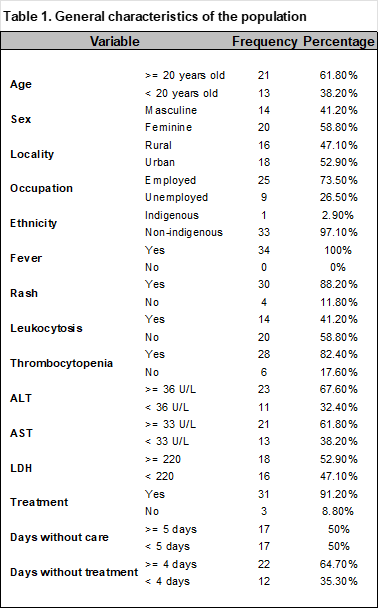
Analysis of ethnicity revealed that only 2.9% of patients were indigenous, while 97.1% were non-indigenous. The presence of fever, a cardinal symptom in the diagnosis of rickettsiosis, was documented in all patients. Furthermore, 88.2% (30 individuals) presented a rash, which may be an indicator of severity and a common skin manifestation in this disease.
Regarding treatment, a high percentage (91.2%) of patients received medical attention, although it was recorded that 50% (17 patients) did not receive adequate care for at least 5 days and 64.7% (22 patients) did not receive adequate treatment for at least 4 days. These data highlight the importance of early intervention in the management of rickettsiosis and its impact on fatality.
Table 2 provides a detailed overview of the general characteristics of patients who died from rickettsiosis. Of a total of 13 deaths, 38.5% (5 individuals) were under 20 years of age and 61.5% (8 individuals) were greater than or equal to 20 years of age. This indicates that, although mortality affects both age groups, most deaths occur in adults, which could imply greater severity of the disease in this population.
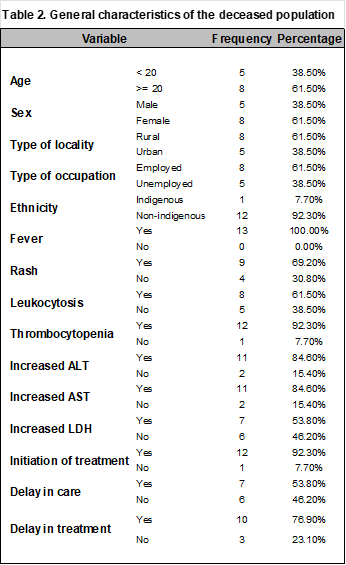
Regarding sex, the results show that 38.5% (5 men) and 61.5% (8 women) died, suggesting a slight trend towards greater fatality in women, although the total number of cases is low. Regarding the type of location, 61.5% of the deceased came from rural areas, which could be associated with factors such as limited access to health services, while 38.5% resided in urban areas.
Analyzing the type of occupation, it was found that 61.5% of the deceased had some type of employment, which raises questions about the relationship between work activity and exposure to risk factors for rickettsiosis. In terms of ethnicity, only one patient (7.7%) was Indigenous, while 12 (92.3%) were non-Indigenous, reinforcing concerns about healthcare disparities.
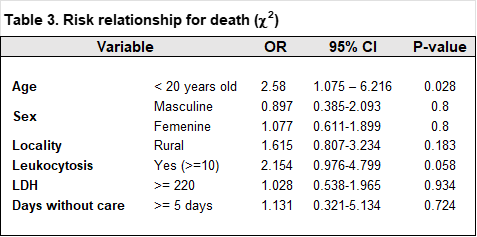
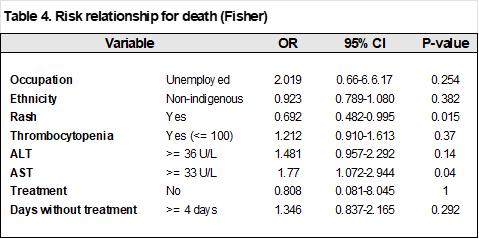
For the risk relationship, the Odds ratio (OR) based on the Chi-square test (Table 3) was used to evaluate factors associated with mortality. It is observed that patients under 20 years of age have an OR of 2.58 (95% CI: 1.075 – 6.216, p = 0.028), which indicates that this group has more than twice the probability of dying compared to older adults (Table 4).
The goodness of fit of the model (Table 5) through different statistical criteria. The deviation value is 2.726 with 19 degrees of freedom, resulting in a value of 0.143, which indicates a good fit of the model to the data. The scaled deviation is 34,000, suggesting that the model is adequately fitted. Pearson's chi-square also shows a value of 2.726 (p = 0.143), supporting the claim that the model fits the data well. Information criteria, such as the AIC (42.691) and BIC (67.112), are useful for comparing the quality of fit with other models, where lower values indicate a better fit. The log-likelihood function is -5.345, which is also used in the calculation of the information criteria.
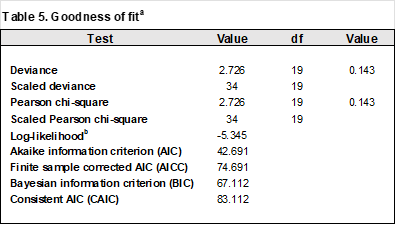
Table 6 presents the model's effect tests using Wald's chi-squared test. The intercept is highly significant (Chi-square = 27.534, p < 0.001), reinforcing the model's validity. The age variable is also identified as significant (Chi-square = 5.282, p = 0.022), indicating that age is an important predictor of case fatality. In contrast, sex (Chi-square = 0.009, p = 0.926), type of location (Chi-square = 1.628, p = 0.202), and type of occupation (Chi-square = 0.885, p = 0.347) did not show statistical significance. However, ethnicity is significant (Chi-square = 4.313, p = 0.038), indicating that this factor should be considered in mortality analysis.
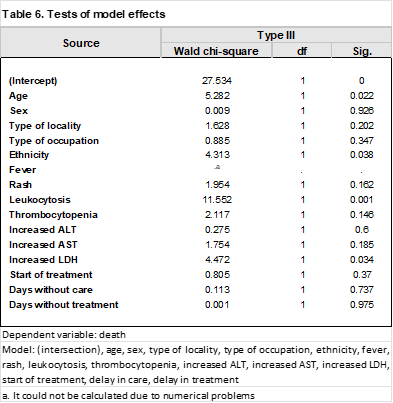
The results of this statistical analysis provide valuable information on the factors that influence mortality from rickettsiosis. The most significant variables include age, ethnicity, and leukocytosis, which are directly associated with the risk of death.
DISCUSSION
By reviewing 34 confirmed cases between 2021 and 2022, population characteristics, clinical characteristics and critical aspects in clinical and public health intervention were analyzed. The results show that 61.8% of patients were over 20 years old, which is consistent with other studies reporting greater susceptibility in adults, possibly due to factors such as occupation and lifestyle, which increase exposure to vectors.16,17 Furthermore, the predominance of women in the total cases (58.8%) could reflect variations in exposure or immune response, although no significant correlation was found between gender and mortality, in accordance with previous studies.18,15
The distribution of patients in urban and rural areas (52.9% and 47.1%, respectively) underscores the importance of environmental factors and access to medical services during rickettsiosis.19,20
The hematological findings of this study, such as the high prevalence of thrombocytopenia (82.4%) and leukocytosis (41.2%), reinforce the idea that these alterations are common in severe cases of rickettsiosis. Thrombocytopenia, indicative of systemic inflammation and possible endothelial damage, has been identified in previous studies as a predictor of poor prognosis.14,21Similarly, liver function tests revealed elevated ALT and AST levels in a high percentage of patients, suggesting that rickettsiosis may be frequently associated with liver damage, increasing the risk of adverse outcomes.8,13
The study also highlights the importance of timely treatment. However, the analysis showed that 50% of patients did not receive timely medical attention, and 64.7% experienced delays in specific treatment. These data are consistent with research that underscores the need for early intervention with antibiotics, such as doxycycline, to reduce mortality.22,4 Delays may be related to lack of access to medical services, difficulty in early diagnosis, and limited availability of diagnostic tests, compromising the prognosis of patients in low-resource communities.18,3 Mortality analysis reveals a higher proportion of deaths in adults (61.5%), which could be linked to greater severity in this age group. The predominance of deaths in rural areas (61.5%) highlights the need to improve healthcare infrastructure and access to health services in these areas, consistent with other studies that point to the impact of the rural environment on clinical outcomes.16,17,15The observed relationship between occupation and case fatality, with 61.5% of those who died being employed, suggests an association between occupational exposure and the risk of infection, which is consistent with the literature on rickettsiosis in vector-borne populations.21,3,20
The study used statistical analyses such as odds ratio (OR) calculations and chi-square tests to identify predictors of mortality. The OR for patients under 20 years of age (2.58, 95% CI: 1.075–6.216, p = 0.028) suggests that this group has a significantly higher risk of death. This finding highlights the vulnerability of young people to rickettsiosis, supporting the need for specific intervention strategies.6,9 However, variables such as sex and location did not reach statistical significance, indicating that these factors may not be determinants of mortality in this population.18,8
Ethnicity was also identified as a relevant factor; Indigenous patients showed a lower risk of lethality, which could be due to cultural, genetic, or healthcare access factors. This finding is consistent with other studies that suggest ethnic disparities in rickettsiosis outcomes.23,15 Furthermore, biomarkers such as LDH, ALT, and AST, although not all statistically significant, suggest a possible role in identifying at-risk patients, as elevated transaminase levels have previously been associated with a higher risk of mortality.13,24,20
The study confirms the existence of specific factors that predict mortality in rickettsiosis and establishes a solid foundation for future research addressing the determinants of lethality in this infectious disease in Mexico and other endemic regions.21,4,6
Finally, although the study provides valuable data, it is important to acknowledge its limitations. The sample size was small, which could restrict the generalizability of the results. This limitation is shared with studies in rural areas of Mexico, such as those by Hernández-Día and Medina-López, who also identified sample size as a barrier to generalizing findings. Furthermore, the focus on a single hospital limits the possibility of evaluating variations in clinical management and outcomes in different care settings; multicenter studies in other contexts could provide a broader perspective and help establish consistent risk patterns at the national and international levels.
This study on the sociodemographic and clinical factors that act as predictors of lethality has allowed for a deeper understanding of the determinants that influence severe outcomes in this infectious disease. Another relevant finding was the relationship between occupation and vulnerability to rickettsiosis. Most affected patients were employed, raising questions about the potential role of work activities in exposure to Rickettsia vectors. Occupations in rural settings or those involving close contact with domestic animals, such as agriculture and livestock care, may be associated with a higher risk of infection.
The analysis also demonstrated that access to timely care is a determining factor in the prognosis of rickettsiosis. Approximately half of the patients experienced a delay in medical attention, which is associated with a higher likelihood of severe outcomes. This delay in access to care is alarming, as the early administration of specific antibiotics, such as doxycycline, is crucial for reducing mortality. The lack of early access to health services could be linked to geographic, economic, or medical resource availability factors, especially in rural areas. The evidence gathered in this study suggests an urgent need to improve access to healthcare services in areas endemic for rickettsiosis, promoting the availability of antibiotics and training medical personnel in the early recognition of symptoms to reduce waiting times for care and treatment.
Another key finding is the difference in clinical outcomes between urban and rural populations. While this study did not find a statistically significant association between location and case fatality rate, descriptive analysis showed that a large proportion of severe cases and deaths originated in rural areas. This pattern could reflect the difficulties rural communities face in accessing quality healthcare services, as well as greater exposure to rickettsiosis vectors in areas where cohabitation with domestic animals is common. These results highlight the importance of prioritizing resources and intervention programs in rural communities, where rickettsiosis poses a significant public health risk and resources are often limited.
The future applications of this study are broad, ranging from optimizing clinical resources to implementing preventive and vector control policies in high-risk communities. Strengthening early diagnosis, improving access to treatment, vector control, and targeted epidemiological surveillance constitute a comprehensive strategy that, if applied consistently, could reduce the burden of rickettsiosis in the country and improve health outcomes in the most affected populations.
REFERENCES
1.Pascucci I, Antognini E, Canonico C, Montalbano MG, Necci A, Di Donato A, et al. One health approach to rickettsiosis: A five-year study on spotted fever group rickettsiae in ticks collected from humans, animals and environment. Microorganisms. el 1 de enero de 2022;10(1).
2.Martínez-Ortiz D, Torres-Castro MA, López-Ávila K, Koyoc-Cardeña E, Manrique-Saide P. Rickettsia spp. en garrapatas (Acari: Ixodidae) que infestan perros de una comunidad rural con antecedentes de rickettsiosis, Yucatán, México. Rev Biomed. el 8 de mayo de 2019;30(2).
3.Gottlieb M, Long B, Koyfman A. The Evaluation and Management of Rocky Mountain Spotted Fever in the Emergency Department: a Review of the Literature. J Emerg Med. el 1 de julio de 2018;55(1):42–50.
4.Blanco JR, Oteo JA. Rickettsiosis in Europe. En: Annals of the New York Academy of Sciences. Blackwell Publishing Inc.; 2006. p. 26–33.
5.López-Castillo DC, Vaquera-Aparicio D, González-Soto MA, Martínez-Ramírez R, Rodríguez-Muñoz L, Solórzano-Santos F. Rocky Mountain spotted fever: Five years of active surveillance experience in a second level pediatric hospital in northeastern Mexico. Bol Med Hosp Infant Mex. el 1 de septiembre de 2018;75(5):304–8.
6.Ngamprasertchai T, Hanboonkunupakarn B, Piyaphanee W. Tropical Medicine and Infectious Disease Rickettsiosis in Southeast Asia: Summary for International Travellers during the COVID-19 Pandemic. Trop Med Infect Dis. 2022;7(18):1–11. Disponible en: https://doi.org/10.3390/tropicalmed7020018
7.Linero K, Serrano S, Florian D. Rickettsiosis: La importancia de realizar un diagnóstico y manejo precoz. Pediátrica de Panamá. el 30 de abril de 2022;51(1):30–8.
8.Silva-Ramos CR, Hidalgo M, Faccini-Martínez ÁA. Clinical, epidemiological, and laboratory features of Rickettsia parkeri rickettsiosis: A systematic review. Vol. 12, Ticks and Tick-borne Diseases. Elsevier GmbH; 2021.
9.Drexler NA, Close R, Yaglom HD, Traeger M, Parker K, Venkat H, et al. Morbidity and Functional Outcomes Following Rocky Mountain Spotted Fever Hospitalization - Arizona, 2002-2017. Open Forum Infect Dis. el 1 de octubre de 2022;9(10).
10.Bol Clin Hosp Infant Edo Son. 2011;28(2):44–50. Disponible en: https://www.medigraphic.com/pdfs/bolclinhosinfson/bis-2011/bis112b.pdf
11.Fiebre manchada de las Montañas Rocosas en pediatría: Revisión clínica de una serie de 115 casos. Disponible en: https://www.medigraphic.com/pdfs/revenfinfped/eip-2008/eip083c.pdf
12.Quintero Vélez JC, Hidalgo M, González R. Rickettsiosis, una enfermedad letal emergente y re-emergente en Colombia [Internet]. Vol. 17. Colombia; 2012. Disponible en: www.javeriana.edu.co/universitas_scientiarum
13.Miranda RJ, Mattar VS, González TM. Rickettsiosis. Rev MVZ Cordoba. el 1 de mayo de 2017;22:6118–33.
14.Alvarez-Hernandez G, Murillo-Benitez C, Del Carmen Candia-Plata M, Moro M. Clinical profile and predictors of fatal Rocky Mountain spotted fever in children from Sonora, Mexico. Pediatr Infect Dis J [Internet]. 2015 [citado el 24 de junio de 2023];34(2):125–30. Disponible en: https://pubmed.ncbi.nlm.nih.gov/25126856/
15.Hernández-Díaz M. Mortalidad por fiebre manchada en el noreste de México: un estudio de factores asociados. Coahuila, México; 2017.
16.Gómez-Sánchez M, Rivera-Torres L. Letalidad de la fiebre manchada en el noroeste de México. Sonora, México; 2018.
17.Rodríguez-Mendoza P, Castillo-Ríos J. Factores asociados a la mortalidad por rickettsiosis en el Hospital General de Ciudad Obregón. Sonora, México; 2021.
18.Medina-López S, Torres-López A. Incidencia y factores de riesgo de rickettsiosis en zonas rurales de México. Chiapas, México; 2022.
19.Field-Cortazares J, Escárcega-Ávila AM, López-Valencia G, et al. Seroprevalencia y factores de riesgo asociados a riquetsiosis (Rickettsia rickettsii) en humanos de Ensenada, Baja California, México. Gac Med Mex. 2015;151(1):42-46.
20.Brown L, et al. Clinical outcomes and epidemiologic characteristics of rickettsiosis in low-resource areas. Texas, Estados Unidos; 2019.
21.Alvarez-Hernandez G, Murillo-Benitez C, Del Carmen Candia-Plata M, Moro M. Clinical profile and predictors of fatal Rocky Mountain spotted fever in children from Sonora, Mexico. J Pediatr Infect Dis. 2015;34(2):125–30.
22.Smith J, et al. Demographic and clinical predictors of mortality in Rocky Mountain spotted fever cases. Arizona, Estados Unidos; 2019.
23.Oteo JA, Nava S, de Sousa R, Mattar S, Venzal JM, Abarca K, et al. Guías latinoamericanas de la RIICER para el diagnóstico de las rickettsiosis transmitidas por garrapatas. Rev Chilena Infectol. 2014;31(1):54–65.
24.Dincy PCV, Susanne PA, Leni G, Sohanlal T, Meera T, Prakash John AJ. Clinicopathological study on rickettsial spotted fever from south India. Trop Doct. el 1 de octubre de 2018;48(4):325–9.
Citation
Becerra-Cervantes AL and Ruiz-Valdez CA, Sociodemographic factors predicting lethality from rickettsiosis. ERSJ 2026,2(1) 4-17
Academic Editor: Porfirio Felipe Hernández Bautista, Received: August-5-2025, Revised: July-3-2026, Accepted: July-3-2026, Published: July-18-2026.